
- The client is a next-generation intelligent energy platform that provides SaaS solutions that enable energy suppliers modernize their operations.
- Headquartered in the UK, the client has its presence across continents.
- They serve millions of energy customers while driving decarbonization at scale.

Success Story
About the Client
Business Needs | Unifying Fragmented Multicloud Infrastructure Through Large-Scale Migration
- The client’s existing containerized workloads were independently handled across cloud accounts on AWS and GCP.
- This led to fragmented infrastructure management, inconsistent governance practices, and rising operational costs while allowing the team to function with autonomy.
- The lack of a centralized DevOps framework limited standardization in infrastructure provisioning, deployment practices, and operational monitoring across services.
- The client needed to modernize its cloud infrastructure by migrating 60+ services and databases to a centrally governed platform that could support standardized DevOps processes, improved cost control, and stronger compliance.
- The migration process also included consolidating existing data stores such as DynamoDB, RDS, PostgreSQL, and other services under a unified infrastructure and governance model.
- This large-scale multicloud migration used a hybrid strategy: lift-and-shift approach for straightforward workloads and targeted modernization for complex services.
- They expected accelerated migration execution while adhering to DevOps best practices for automation, governance, operational resilience, and cost optimization.
- The distributed cloud landscape also limited end-to-end visibility across services, making it difficult to monitor performance and maintain consistent operational oversight.
- Different teams followed varying deployment and operational practices, creating inconsistencies that hindered scalability and increased management complexity.
Solutions | Migrating and Modernizing Services to a Centrally-Governed AWS EKS Platform
- We began with a migration assessment using our DART (Discover–Assess–Recommend–Transform) framework to evaluate application dependencies, infrastructure requirements, and migration risks.
- Based on these insights, we designed a strategic migration plan aligned with the proposed hybrid migration approach and DevOps operating model.
- We migrated the services and databases to a centrally managed AWS EKS-based Kubernetes platform, enabling standardized container orchestration and governance.
- The engagement introduced GitOps-driven deployment processes, automated CI/CD workflows, centralized observability, and Infrastructure-as-Code practices to improve operational control and strengthen DevOps automation.
- The automation enabled the engineering teams to provision, modify, and validate infrastructure through code-driven workflows, reducing manual effort and ensuring reliable deployments with minimal downtime.
- Through our PIE methodology, we embedded DevOps governance using agile maturity metrics to track progress, enforce accountability, and ensure on-time delivery throughout the migration cycle.
- The solution established a secure multi-account AWS environment with VPC-based network isolation, IAM controls, and standardized governance practices, creating a scalable and resilient foundation for future growth.
- Assessed the database estate, upgraded 65+ databases, and decommissioned obsolete instances to reduce costs, simplify operations, and strengthen governance.
- Planned and executed Disaster Recovery (DR) exercises to validate backup, failover, and recovery processes, ensuring operational readiness.
- Migrated large-scale databases containing trillions of records using AWS DMS, enabling seamless data migration with optimized replication and minimal downtime.
- Migrated CI/CD pipelines from CircleCI to GitHub Actions, standardizing build and deployment workflows while simplifying pipeline management.
- Modernized the Terraform framework by upgrading legacy versions, validating provider compatibility, and resolving issues to establish a stable Infrastructure-as-Code foundation.
Business Impact | Accelerating Delivery and Standardizing Operations Through Migration and Modernization
- Successfully migrated nearly 60 services and databases to the unified platform by following a scientific and phased execution approaches.
- Achieved consistent DevOps practices across environments by automating infrastructure provisioning and deployment workflows thus improving operational reliability and deployment efficiency.
- Strengthened governance and streamlined infrastructure through a centralized platform, reducing complexity, optimizing costs, and enabling a scalable DevOps foundation.
- Reduced operational overhead and improved developer productivity through automation, standardized workflows, and centralized platform management.
- Reduced infrastructure costs and improved operational efficiency by modernizing end-of-life databases and decommissioning unused instances.
- Validated backup, failover, and recovery processes through successful DR exercises, improving resilience, and recovery preparedness.
- Successfully migrated business-critical databases containing trillions of records while maintaining data integrity and minimizing downtime.
- Standardized CI/CD pipelines by migrating to GitHub Actions, simplifying deployment processes, and improving engineering productivity.
- Modernized the Terraform framework by upgrading legacy versions and improving automation consistency, creating a scalable and maintainable Infrastructure-as-Code foundation.
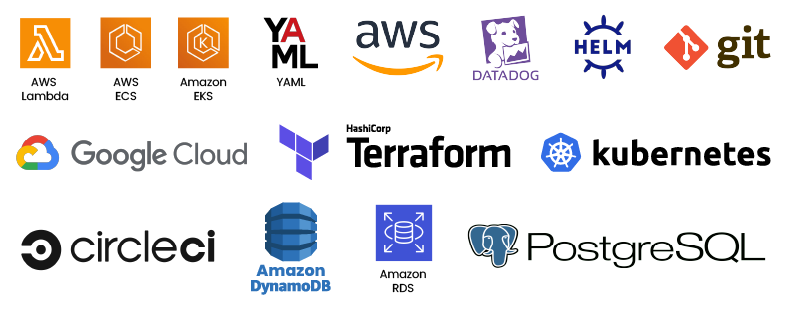
Technology Stack
Image
Related Success Stories
Success Stories

Posted On:
AI-Native Security Review Identified ~99.99% of Security…
Cybage embedded AI-powered security validation into development workflows to detect vulnerabilities earlier and…
Success Stories
Posted On:
We implemented a Claude-Powered RAG Content Engine and a…
Cybage scaled Claude across Vector Solutions to accelerate content creation and engineering delivery while…


Let's Get Moving!
Your purpose, our passion. Connect with us and let's make things happen.
Image