
The client is a leading UK-based provider of accounting, payroll, and HR solutions. They offer integrated, cloud-based products that help organizations improve efficiency, ensure compliance, and reduce administrative workload. The company focuses on simplifying complex business processes and enabling better decision-making through data-driven insights.

Success Story
About the Client
Business Needs | Front-End Technology Migration
The client sought to modernize their financial platform. The system was built on an older version of AngularJS (1.5.8), which impacted supportability, delivery efficiency, security compliance, and scalability. The risks were operational and compounding, making incremental remediation increasingly unsustainable.
Following were the key issues:
Platform Risk and Technology Obsolescence: These challenges increased exposure in a regulated operating environment and constrained long-term viability
- The use of AngularJS 1.5.8 exposed the platform to security vulnerabilities as it has reached its end-of-support phase.
- Extensive reliance on jQuery introduced significant security and maintenance risk
- Large form states and unmanaged memory leaks led to a performance degradation
Architecture and Delivery Inefficiencies: This reduced engineering productivity and limited the ability to evolve the platform safely
- Managing 100+ controllers with embedded business logic complicated maintenance
- Maintaining over 1,100 lines of tightly coupled routing configuration created inefficiencies
- Limited alignment with modern CI/CD and DevOps practices restricted the platform's ability to evolve.
Solutions | Controlled Modernization and System Upgrade with GenAI
Operating within a regulated environment, the Cybage team initiated a front-end modernization program to ensure the platform remained sustainable, secure, and capable of supporting future enhancements. We leveraged GenAI tools to accelerate development and streamline the modernization process while maintaining high reliability and compliance standards. The response focused on controlled modernization rather than wholesale disruption. Following engineering solutions were applied:
- We developed a parallel Modern Angular application alongside the legacy AngularJS system, enabling module-by-module migration with isolated QA validation and minimal operational disruption.
- We applied Cursor AI to accelerate front-end refactoring activities while enforcing coding standards and maintaining human review for auditability.
- Our team integrated tools such as ESLint and Snyk into the development lifecycle to surface issues early, supported by penetration testing at major releases and SOC audit alignment.
- We redesigned routing to align with Angular Router conventions and decomposed controllers to separate business logic from presentation concerns.
- NgRx was introduced to establish predictable, centralized state management, addressing performance issues caused by large form states and unmanaged memory usage.
- We uplifted the backend from .NET 4.6.2 to .NET 4.8, with a defined roadmap toward.NET 10 (LTS) to ensure long-term supportability and compatibility.
- Dedicated comparison environments were established to continuously validate functional parity between legacy and modernized components throughout the transition.
This approach emphasized stability, traceability, and controlled delivery.
Business Impact | Strengthened Platform Sustainability Through Structured Modernization
- 35% reduction in front-end delivery timelines through governed use of GenAI-assisted development practices.
- 90% reduction in identified security vulnerabilities following framework upgrades, tooling enforcement, and embedded security controls.
- 106 application screens were successfully migrated to Modern Angular application while maintaining functional parity with the legacy system.
- Improved code quality and compliance through enforced linting, repository policies, and automated quality gates, reducing rework and downstream defects.
- Lowered long-term operating costs through tooling consolidation and reduction of legacy framework dependencies.
- Established full alignment of the application stack with supported technologies, improving maintainability and positioning the platform for future scalability and regulatory needs.
- Achieved long-term platform risk by approaching modernization as a structured risk-reduction initiative rather than a full system rewrite.
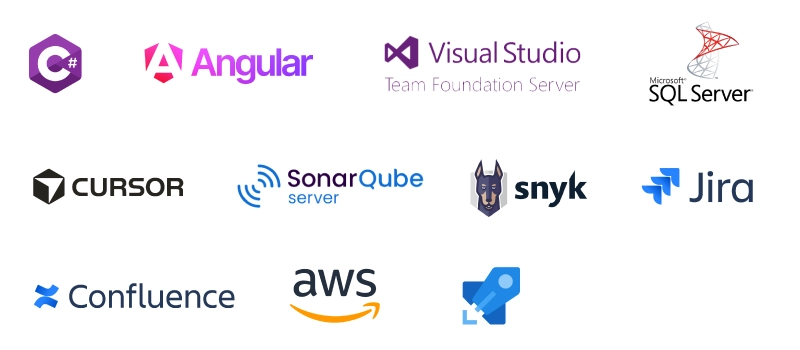
Technology Stack
Image
Related Success Stories
Success Stories

Posted On:
Accelerating Payments Modernization with a Tracer Bullet…
Explore how a tracer bullet development strategy helped a global payments software provider accelerate platform…
Success Stories

Posted On:
Driving Operational Excellence: How Cybage Transformed…
Discover how Cybage improved network performance, accelerated ticket resolution, and strengthened compliance for a…
Sectors We Serve


Let's Get Moving!
Your purpose, our passion. Connect with us and let's make things happen.
Image