

Healthcare organizations gather feedback from almost every point in the patient/member journey. A patient describes a confusing bill, a member questions a denied claim, or a caller expresses frustration after waiting days for an appointment. These interactions contain valuable information about how healthcare services are actually experienced. Yet much of it remains buried in call recordings, chat transcripts, portal messages, surveys, and complaint records.
The impact is never seen in a single evident failure, but rather in repeated calls, unresolved issues, low patient satisfaction, excessive administrative fees, and members who refuse to renew their memberships.
The difficulty is no longer simply getting feedback and determining whether it is positive or negative. It is about understanding the feedback, contextualizing it, and acting on it. That is where AI-powered sentiment analysis starts to play a role in healthcare organizations' service delivery.
Feedback Overload to Meaningful Insight
Healthcare feedback is fragmented across systems that serve different purposes. Contact centers record conversations, patient portals capture messages, surveys collect experience ratings, and complaint management systems track formal grievances. Each source provides a partial view of the experience, but rarely does one system reveal the entire story.
Because reviewing every interaction manually is impractical, organizations typically rely on samples, predefined categories, and selected quality reviews. These methods can identify individual problems, but they struggle to uncover patterns across large volumes of unstructured information.
Consider a health plan member whose claim has been denied. The member contacts customer service and receives an explanation that does not resolve the issue. When they call again, they receive a different explanation. By the third call, their frustration is evident. However, when each interaction is reviewed independently, all three calls might be classified as routine inquiries. The underlying problem, a recurring failure to explain or resolve the same claim, remains hidden.
At scale, these missed connections have business consequences. Repeated contacts increase service costs, unresolved complaints can develop into formal grievances, and dissatisfaction can affect member retention. Providers face similar challenges when positive comments about clinical care coexist with frustration about billing, scheduling, or waiting times. The information is already available. What is missing is the ability to interpret it consistently across channels and identify the patterns that deserve attention.
Beyond Positive Sentiment and Negative Sentiment
Traditionally, sentiment analysis classifies text into one of three categories: positive, negative, or neutral. In healthcare, such classifications can often be too broad to be useful. For instance, a conversation about a denied claim or an unexpected medical bill may naturally carry a negative tone, even when the representative handles the interaction well.
More sophisticated tools will be able to classify emotions (e.g., frustration, anxiety, distress); recognize the intentions, goals, and urgency; and detect whether the speaker describes any particular component of the experience. Aspect-based sentiment analysis can be especially useful if the same message consists of multiple opinions.
For instance, a member might share, "The doctor was excellent, but I have already contacted three people about this claim, and no one explains why it was denied."
The simplest classifier could categorize the whole statement as mixed sentiment. A more nuanced analysis would differentiate between satisfaction with the care provider and frustration with the claims process. Furthermore, multiple contacts would be recognized as an indicator that the problem hasn't been solved yet.
Such differentiation alters the business value of the process. Instead of getting a general dissatisfaction rating, the process can provide assistance in finding out which team should handle the issue.
The real potential, however, lies not only in constructing better classifiers. The true potential consists in providing existing tools with the context necessary to interpret the interaction.
Frustration of the member is valuable information. Frustration of the member who called several times about unresolved claims, received inconsistent information previously, and whose case is still open is much more helpful information.
From Individual Use Cases to Enterprise Capability
There are different applications of AI sentiment analytics within healthcare organizations based on the issues they need to solve. However, the objective is still the same: linking the feedback to the actions that will address the root cause of the feedback.
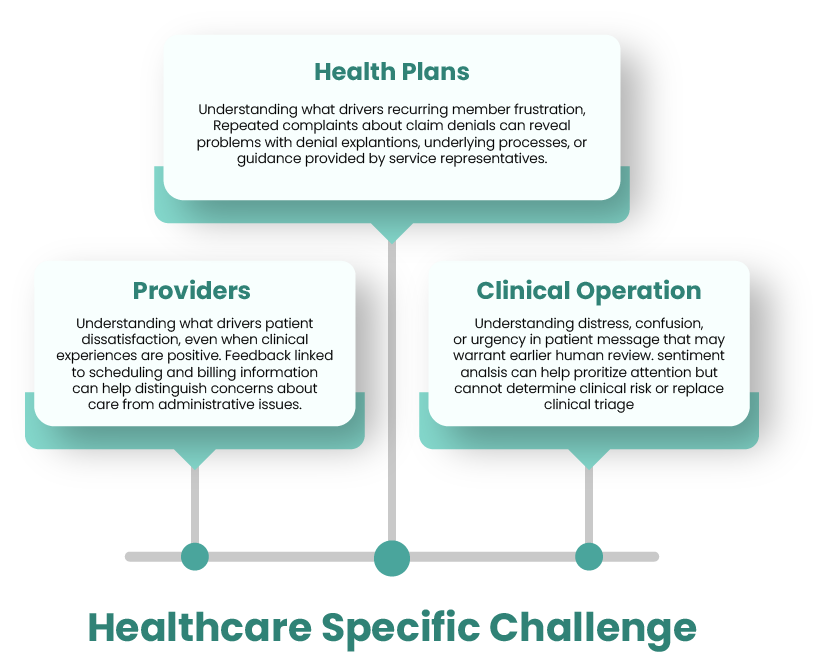
These initiatives may start off with one particular group or problem area, but the real problem may extend into more than one interaction channel. For instance, a health plan may realize that there is frustration with denial of claims via call analysis, whereas a provider may discover that there is ongoing frustration with billing and scheduling. Analyzing each interaction individually will help uncover specific problems, but it may not reveal the broader operational issues causing them.
Why Healthcare Needs More Than a General Sentiment Tool
Healthcare language presents challenges that generic sentiment tools may not handle reliably. Consider the phrase "denies chest pain." The word "denies" describes a clinical statement; it does not indicate dissatisfaction. Similarly, abbreviations such as EOB (explanation of benefits), PA (prior authorization), and SOB (shortness of breath) can be misinterpreted without domain knowledge.
Negation, medical terminology, and the presence of several sentiments in one message make simple word-based classification unreliable. Context matters just as much: "I cannot thank the billing team enough" and "I cannot get the billing team to call back" share similar words but communicate very different experiences.
Large language models can assist with interpreting these nuances; however, this does not mean that they are automatically correct simply because they are more capable. Expert evaluation, representative test data, and performance tracking remain required. Moreover, patient communication may also contain protected health information, necessitating relevant security and access controls under applicable obligations, including HIPAA.
Therefore, a good implementation will not consist merely of a model connected to a dataset. It will be a managed pipeline that involves data ingestion, appropriate privacy controls, context-based analysis, model evaluation, confidence assessment, and integration with business processes.
There must also be clear boundaries regarding what the model cannot do. Uncertain results should be sent for approval; sensitive cases should have relevant procedures in place, and automated actions should be trackable through monitoring and audit.
Greater Autonomy Requires Greater Accountability
An AI agent that can detect frustration is different from an agent that can access the member's record, pull up claim information, and start actions based on that. As AI moves from analyzing feedback to acting on it, it is necessary for organizations to set clear guidelines for how far an agent can go in terms of accessing, deciding, and taking action.
There need to be guardrails about what an agent can and cannot do. The agent can pull up claim information and create follow-up actions, but disputed claims or unresolved complaints may have to be passed on to a human representative. Clinical actions have to adhere to the existing procedures for assessing and escalating clinical issues. Human intervention needs to be incorporated in the process if the effects of the action being taken are significant enough.
Compliance and protection of PHI should be incorporated into the implementation of such solutions. For organizations operating in the US, HIPAA Privacy and Security Rules define requirements related to the use of PHI, access control, and its encryption. In practice, agents should be authenticated with their requests; have access to the information they were granted to use; and maintain audit logs on data access and actions taken. Organizations should also consider obligations connected to using third-party AI services that work with PHI. Where systems operate in the EU or Australia, applicable requirements such as the GDPR and Australia's Privacy Act 1988 must also be considered.
Transparency and traceability are also important aspects that should be taken into account. If the information obtained with the help of AI solutions becomes part of the healthcare process, teams should know the source of this data and how it should be used correctly. Emerging standards such as the HL7 FHIR AI Transparency Implementation Guide can support the identification and tracing of AI-influenced information when it is represented in FHIR-based exchanges. This complements, rather than replaces, security controls and operational oversight.
In conclusion, assessing the performance of an AI agent entails more than just measuring the level of success in sentiment detection. It is also necessary for organizations to gauge whether their behavior is proper, approved, traceable, and in line with existing procedures and safety standards. The idea is to allow AI agents to perform proper tasks within set limits.
The Next Evolution: Sentiment-Aware AI Agents
Today, many sentiment analytics implementations focus on retrospective reporting: identifying dissatisfaction, tracking trends, and understanding what has already happened. The next stage is connecting sentiment analytics with conversation history, unresolved issues, and business rules to influence how interactions are handled in real time.
This becomes particularly relevant as healthcare organizations introduce AI agents for member services, scheduling, billing assistance, and other administrative interactions. At the same time, traditional sentiment analytics helps organizations understand how people feel. Sentiment-aware AI agents can use these insights to determine how to respond, when to seek additional context, and when an issue requires escalation.
Achieving this requires more than integrating a sentiment model into an AI agent. The agent must interpret sentiment in context, access only the information it is authorized to use, and follow defined business rules when deciding on the next action. It must also recognize the limits of its capabilities and involve a human when a situation requires judgment or intervention.
Sentiment analytics helps organizations move beyond identifying dissatisfaction and take appropriate action based on customer feedback. By combining sentiment analytics with conversation history, operational context, and governed decision-making, healthcare organizations can move towards AI agents that do more than answer questions. They can help address unresolved issues, reduce repetitive interactions, and direct concerns to the right teams.
How can Cybage Help?
The conversion of healthcare feedback into insights involves AI capabilities, domain expertise in healthcare, and scalable infrastructure. Cybage assists healthcare organizations in developing AI-powered solutions that enable the discovery of patterns in interactions to generate service improvements.
This includes context-based analysis of feedback from patients, members, and customers through various channels. It also involves cloud and AI engineering by incorporating language models and machine learning into existing applications and processes. The practice of responsible AI encompasses privacy, security, and access controls, with evaluation, monitoring, and human oversight to generate reliable outputs and automated processes. Together, this enables organizations to shift from feedback analysis to acting upon it.
Connect with Our Experts to Turn Healthcare Feedback into Action.
Authored by
Divya Krishnan
Healthcare & Life Sciences, Cybage