
In mature CI/CD environments, specialized tools well suited to particular needs tend to develop. Over time, managing separate systems for continuous integration and deployment can drive up licensing costs, increase operational effort, and add configuration complexity.
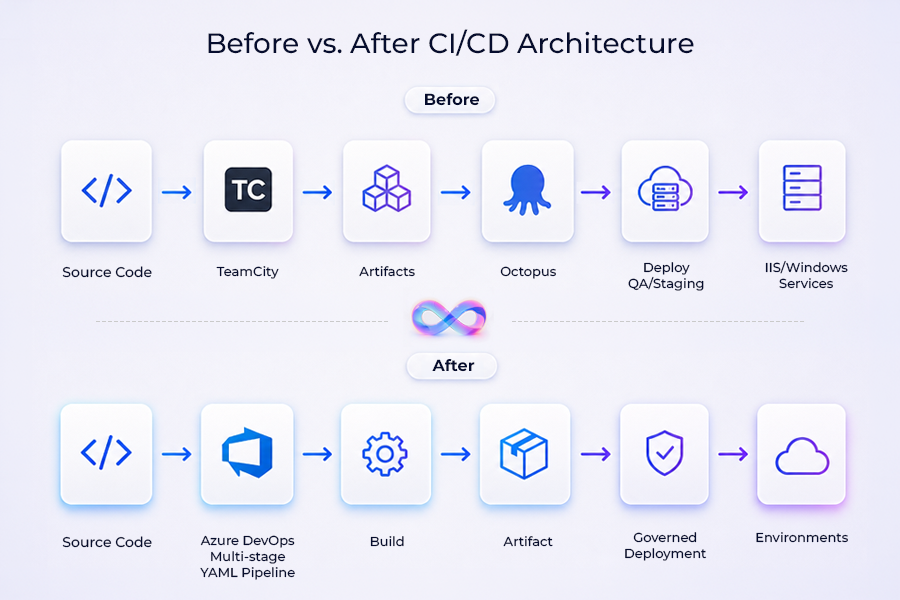
This was the challenge facing an enterprise running .NET and Angular applications with TeamCity for continuous integration and Octopus Deploy for continuous deployment. The environment was mature and functional, but CI and CD remained split across separately licensed platforms.
As services and environments grew, complexity increased. Build and delivery logic spread across tools; environment configurations became harder to manage consistently, and teams lacked a single view of the journey from source code to production-ready deployment.
The modernization objective was therefore broader than replacing TeamCity and Octopus. It was about creating a standardized, reusable, governed, and scalable CI/CD foundation on Azure DevOps.
AI-assisted engineering was also brought into the modernization approach to accelerate repetitive migration activities while retaining engineering oversight and control.
Re-engineering CI/CD Around a Unified Platform
Migrating a mature delivery ecosystem requires more than translating pipelines from one syntax to another. Existing CI/CD toolchain configurations contain years of build logic, deployment sequencing, scripts, dependencies, environment variables, artifact flows, and application-specific patterns.
Modernization began by decomposing these configurations and mapping their capabilities to Azure DevOps-native constructs.
The team re-engineered existing tools to build logic and workflows into version-controlled, multi-stage YAML pipelines. Abstracted common patterns for .NET, Angular, IIS, and Windows Services into reusable, parameterized YAML templates.
This approach reduced duplication and established consistent pipeline patterns across applications.
Azure DevOps CI/CD Environments and Variable Groups centralized environment-specific configuration, and approvals and deployment controls enabled controlled promotion through QA and Staging. Self-hosted agents enable secure deployments to the existing IIS and Windows infrastructure without redesigning the underlying application environment.
The result was a single, integrated flow that linked builds, artifacts, deployments, environments, approvals, logs, and rollout history within one platform.
Modernizing Without Disrupting Delivery
Release continuity was critical because active development could not stop while we replaced the CI/CD foundation.
The transformation used a five-stage migration methodology:
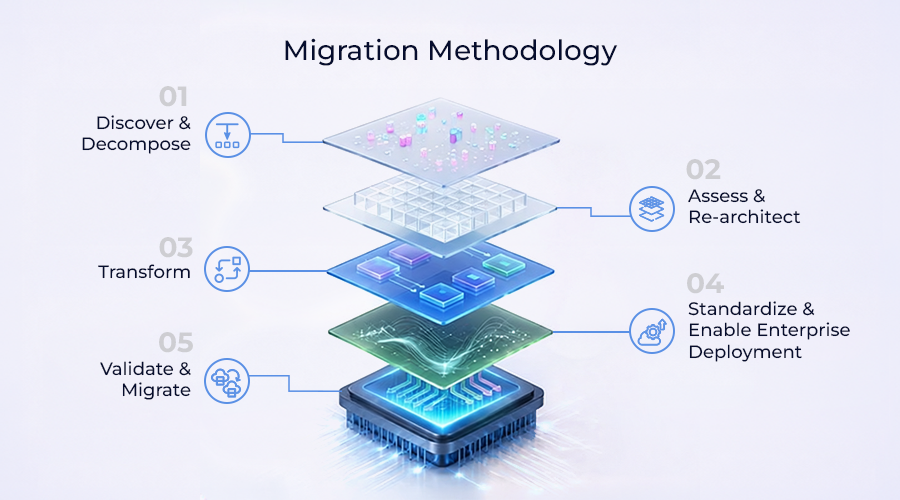
1. Discover & Decompose: We analyzed TeamCity build configurations and Octopus deployment processes to identify steps, dependencies, triggers, artifacts, sequencing, environment-specific configurations, scripts, and delivery targets.
2. Assess & Re-architect: We mapped CI and CD capabilities to appropriate Azure DevOps constructs, consolidating two independently managed platforms into a unified CI/CD architecture.
3. Transform: We converted TeamCity build logic and Octopus deployment workflows into version-controlled YAML pipelines. Common .NET, Angular, IIS, and Windows Service patterns were abstracted into reusable templates.
4. Standardize & Enable Enterprise Deployment: We leveraged Azure DevOps multi-stage workflows, Environments, self-hosted agents, Variable Groups, and delivery controls to manage environment-specific configurations and controlled releases across QA and Staging.
5. Validate & Migrate: We validated the new processes against legacy workflows for testing, artifact handling, configuration, and deployment behavior. Phased migration and controlled cutover minimized disruption to active development and release cycles.
Parallel validation helped preserve functional parity while reducing cutover risk.
Using AI to Accelerate Migration Engineering
AI-assisted engineering complemented this methodology by speeding up several of the configuration-heavy and repetitive tasks throughout the migration lifecycle. We used Cursor to examine the pipeline configurations, spot reusable patterns, convert the existing CI/CD steps into YAML, deal with the migration problems, and improve the technical documentation.
This approach aligns with Cybage's broader AI-infused cloud engineering strategy, where purpose-built agentic capabilities are being applied across cloud modernization and CI/CD engineering.
In the CI/CD and Release Engineering space, these capabilities include pipeline generation, pipeline migration, deployment strategy advisory, flaky-test detection, and release-gate configuration. They complement broader agentic capabilities such as the Pipeline Architect Agent, which supports pipeline-as-code design and standardization.
We never regarded AI-generated changes as being ready for production by default. Each change was checked by engineers to make certain that it maintained the same functionality, met security requirements, and was in line with the standard release procedures. This method sped up the repetitive tasks while still keeping human supervision.
The intent is not to replace engineering judgment, but to use AI and agentic capabilities to reduce repetitive effort, accelerate transformation, and improve consistency across modernization activities.
Turning Migration into Measurable Improvement
Consolidating CI and CD on Azure DevOps eliminated the need for separately licensed legacy deploy platforms by leveraging the existing Azure ecosystem.
More importantly, the redesigned delivery model improved how teams engineer and manage workflows. The result impacted:
- ~30% reduction in operational overhead by minimizing tool switching, manual coordination, and platform complexity.
- ~40% reduction in pipeline onboarding effort through reusable and standardized YAML templates.
- ~40% improvement in CI/CD execution and release turnaround, enabling faster and more efficient delivery.
Centralized environments, configuration, approvals, logs, and release history improved traceability and established stronger governance. Reusable pipeline patterns also created a foundation that can scale as applications and deployment environments expand.
This standardized foundation also creates the right base for broader AI-led engineering, where agentic capabilities can increasingly support pipeline design, migration, release governance, and optimization.
Ultimately, the value of CI/CD modernization lies beyond replacing tools. By combining platform consolidation, pipeline-as-code, reusable engineering patterns, governance, and AI-assisted upgrade, enterprises can turn fragmented delivery processes into a scalable engineering foundation.
As AI capabilities mature, this foundation can further evolve toward agentic engineering, where AI supports engineers across modernization, release, operations, and optimization while human oversight remains central.
Explore our case studies to learn more.