
How Specification-Driven Development Fixes AI's Biggest Blind Spot
Across every industry, teams are arriving at the same uncomfortable truth: the faster AI writes code, the more expensive a vague requirement becomes.
Somewhere in your organization, right now, a developer types a sentence into an AI coding assistant and presses enter. Seconds later, clean, well-structured, confidently formatted code scrolls up the screen. It looks finished. It looks right. And there is a real, non-trivial chance that it solves precisely the wrong problem, because no one ever wrote down a precise definition of the right one.
The developer does not notice. Neither does the reviewer, who sees tidy code that passes its tests. Neither does the product manager, who asked for something “like a summary” and will not see the gap until a customer does. The mistake was never in the code. It lived upstream, in the quiet space between what one person meant and what everyone else assumed.
This is not a failure of AI capability. It is a failure of intent transmission. And here is the part that should keep engineering leaders awake: as AI tools grow faster and more capable, this failure mode does not shrink. It scales.
Software engineering research has pointed to requirements as the primary source of project failure for as long as we have measured it. What is new is the consequence. AI systems amplify ambiguity at speed, turning vague input into polished, plausible, authoritative-looking output, and making that output harder, not easier, to question. Specification-Driven Development is the emerging answer. This piece follows the problem from its roots, weighs the evidence for the fix, walks through working implementations you can run today, and draws out what it means for engineering and business teams alike.
THE SCALE OF THE PROBLEM
Most Software Failure is Decided Before a Single Line of Code is Written
The numbers have barely moved in decades, which is itself a kind of evidence, a measure of how little the industry has managed to absorb them:
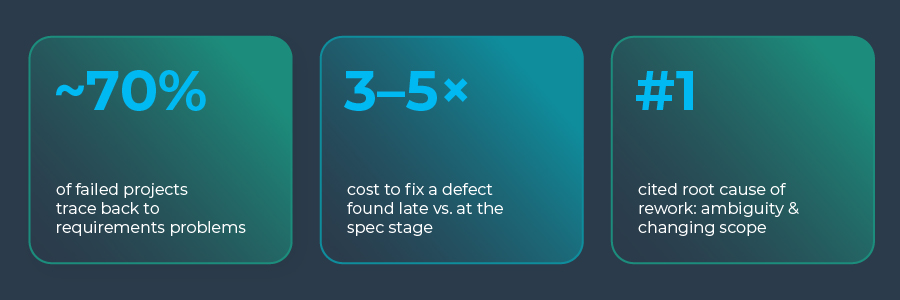
These figures trace back to the foundational literature on agile specification-driven development, notably the work of Ostroff, Makalsky and Paige (2004), which argued for treating specifications as executable, verifiable artifacts rather than static documents to be filed and forgotten. What has changed since is leverage. AI now applies force to both sides of the equation at once: the speed at which a wrong requirement becomes wrong code, and the polish with which that wrong code presents itself as done.
Six Ways Intent Gets Lost
Before a business requirement becomes running software, it passes through many hands, interpretations, and systems. At each handoff, something can, and statistically does, go wrong:
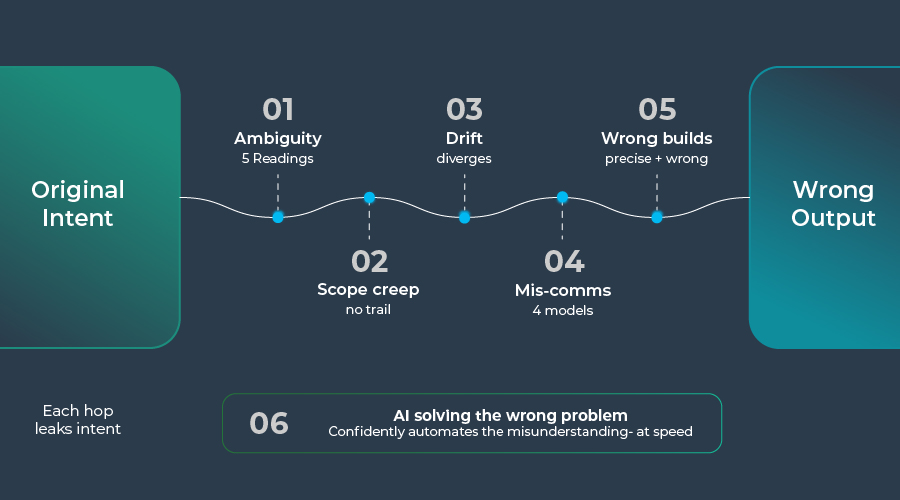
Six pathways through which intent degrades between conception and delivery
- Requirement ambiguity: "Summarize the notes" means five different things to five people. AI picks one interpretation and executes it with full confidence.
- Scope creep: Undocumented additions accumulate with no decision trail; in an AI workflow they propagate silently.
- Requirement drift: What is being built slowly diverges from what was agreed, often unnoticed until QA or production.
- Miscommunication: Product, design, engineering and QA hold materially different mental models of the same feature.
- Wrong implementation: A precisely correct build of an imprecisely stated requirement: technically flawless, functionally wrong.
- AI solving the wrong problem: A model confidently automates the misunderstanding, at the speed of generation rather than human effort.
The final pathway is not just one more entry on the list; it is a qualitative change. Earlier eras handed teams slow, expensive wrong implementations: failures that surfaced in reviews and were usually caught before shipping. AI-assisted development hands teams fast, cheap, well-formatted wrong implementations that sail straight through those same review gates precisely because they look correct.
THE VALUE SHIFT
Code is Becoming a Commodity. Specifications are the New Differentiator.
Every major wave of software development solved the bottleneck of its era, and in solving it, exposed the next one. Follow that pattern far enough and it explains exactly why specification has become the new center of gravity for value.
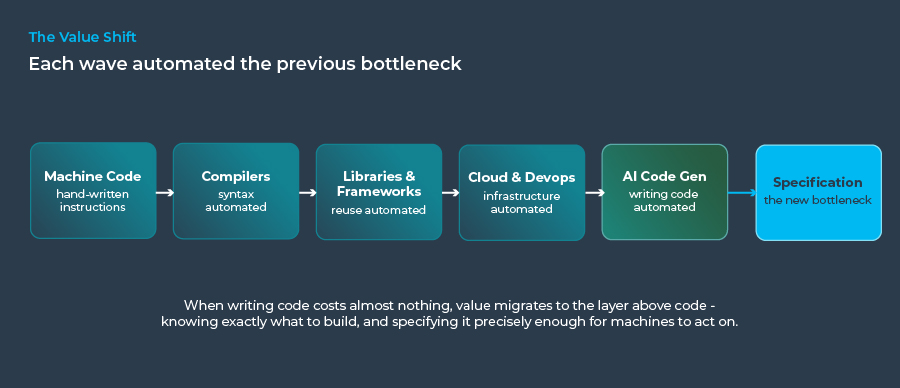
Each era automated the previous bottleneck. AI removed the cost of writing code itself.
The implication is simple once you say it out loud: when writing code costs almost nothing, value migrates to the layer directly above code. The most valuable capability on an AI-assisted team is no longer the ability to write functions; it is the ability to specify intent precisely enough for a machine to act on it correctly.
GETTING CHEAP
| GETTING VALUABLE
|
THE PRACTICE
What Specification-Driven Development Actually Means
Specification-Driven Development is a practice in which a structured, version-controlled specification is the single source of truth, and code, tests, and documentation are generated and validated against it, rather than the other way around.
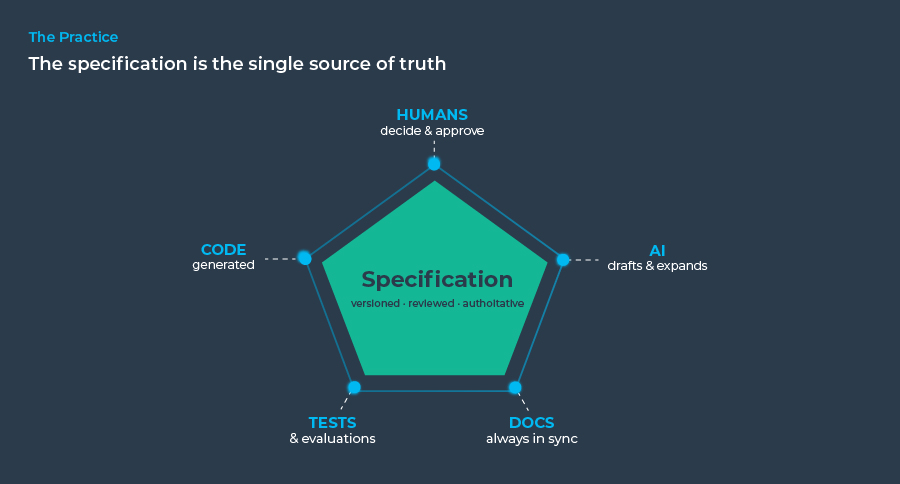
The specification as single source of truth: humans and AI author it; code, tests and docs derive from it
The defining constraint: the spec is written for humans AND machines at the same time: precise enough to generate code from, readable enough to review and govern. AI drafts, expands, and implements. Humans decide and approve. The spec, not the code, is the authority.
That authority plays out across six linked stages, each one traceable back to the same reviewed specification:
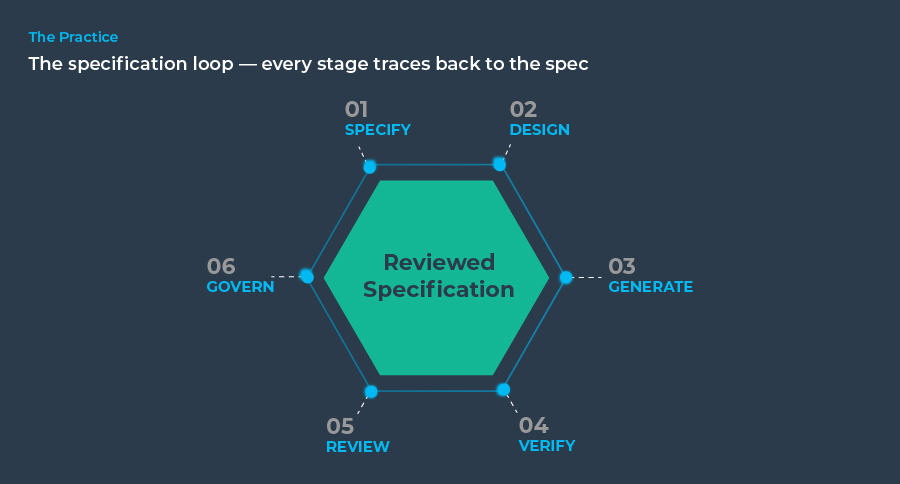
The specification loop: every stage traces back to the reviewed specification
What a Specification Actually Looks Like in Practice
A well-formed requirement is not prose; it is structured, scenarized, and measurable. Here is a real one, taken from a meeting-notes assistant built on exactly these principles:
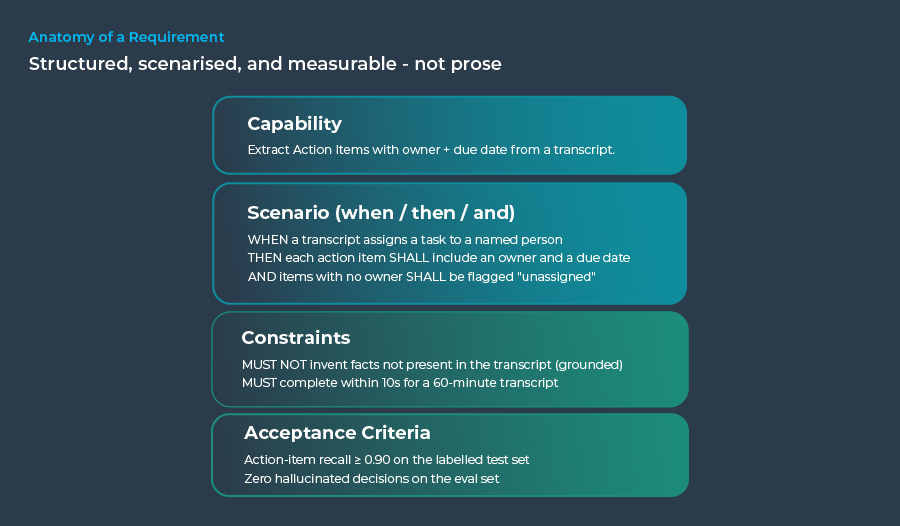
The anatomy of a specification requirement: capability, scenario, constraints and acceptance criteria
The WHEN/THEN/AND scenario format is machine-parseable and directly testable. The grounding constraint, “MUST NOT invent facts not present in the transcript,” is not aspirational language; it is an executable rule a verifier enforces on every run. And the acceptance criteria name a number, 0.90 recall, rather than a subjective bar. Done is defined before generation, not after.
THE EVIDENCE
The Hallucination a Spec Catches: A Concrete Demonstration
Here is what is genuinely new: we can now demonstrate, concretely, reproducibly, in front of a skeptical room, how a specification changes the quality of AI output. Take a realistic six-line meeting transcript. Hand it to an AI assistant with a single, unspecified instruction: “Give me the brief and the action items.” Then watch what unfolds across four short acts.
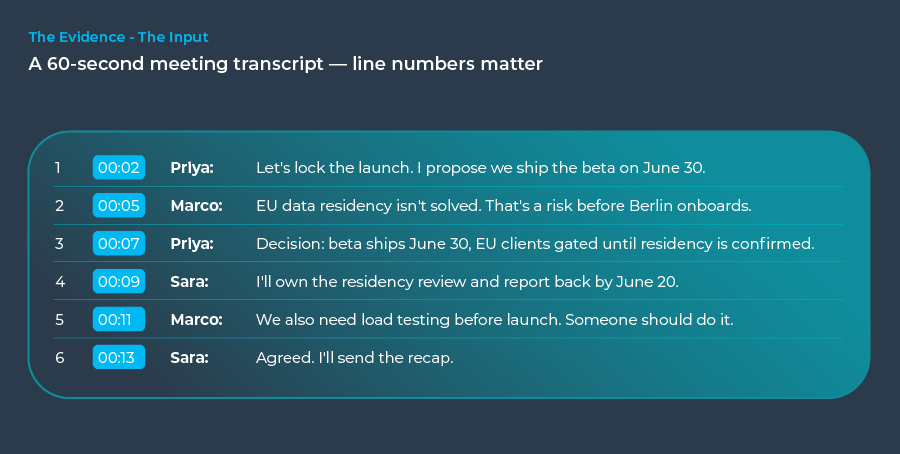
The input: a 60-second meeting transcript. Line numbers matter for what follows.
Note: the walkthrough below uses a meeting-notes assistant rather than a software coding task. We picked a non-coding example on purpose, so the mechanics of grounding, ownership and verification are easy to follow at a glance, and the same specification discipline applies directly to the AI-assisted coding work the three frameworks further down are built for.
Act 1: With No Specification
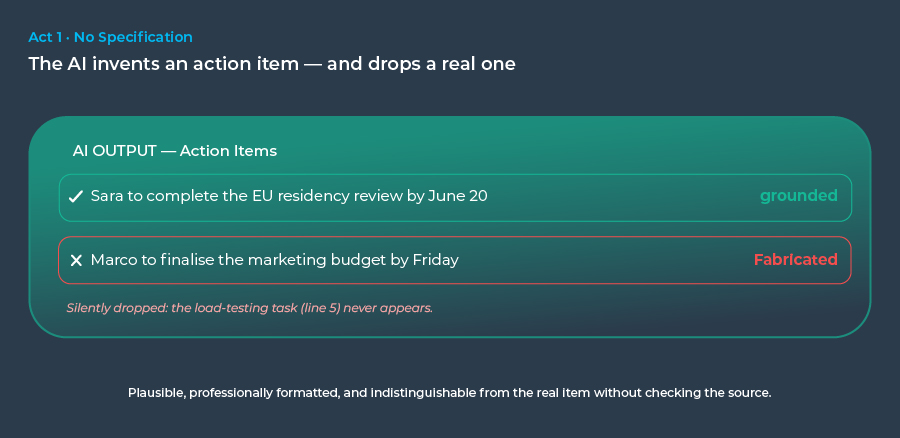
Act 1: without a specification, the AI produces two action items. One is a complete fabrication.
Look closely at the second action item: “Marco to finalize the marketing budget by Friday.” It appears nowhere in the transcript. Worse, the AI has quietly dropped a real action item, the load testing, while inventing this one. The fabrication is plausible, professionally formatted, and, without cross-checking every line against the source, indistinguishable from the genuine article. In a real workflow, this is the version that ships as the meeting summary.
Nothing flagged it. No error, no warning, no red underline. The system was not broken; it was doing exactly what it was asked. That is the quiet danger: the wrong answer arrives wearing the same confident face as the right one.
Act 2: With Specification
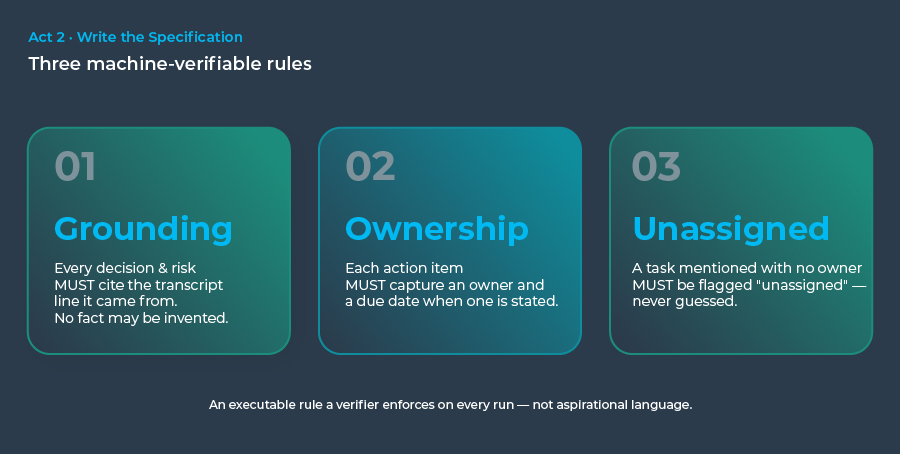
Act 2: an executable specification is written, three machine-verifiable rules
The response to Act 1 is not a better prompt. It is a specification the AI must satisfy before its output can ship, and it comes down to three rules a verifier can actually check. Grounding requires every decision and risk to cite the exact transcript line it came from, so no fact can be invented without leaving a trace back to the source. Ownership requires each action item to carry a named owner and a due date whenever the transcript states one. Unassigned closes the exact gap that let the load-testing task disappear in Act 1: any task mentioned with no owner must be flagged unassigned, never dropped or guessed at.
None of this lives as guidance in a document nobody rereads. Each rule is written so a verifier enforces it automatically, on every single run, before a brief ever reaches a human.
Act 3: The Grounding Check
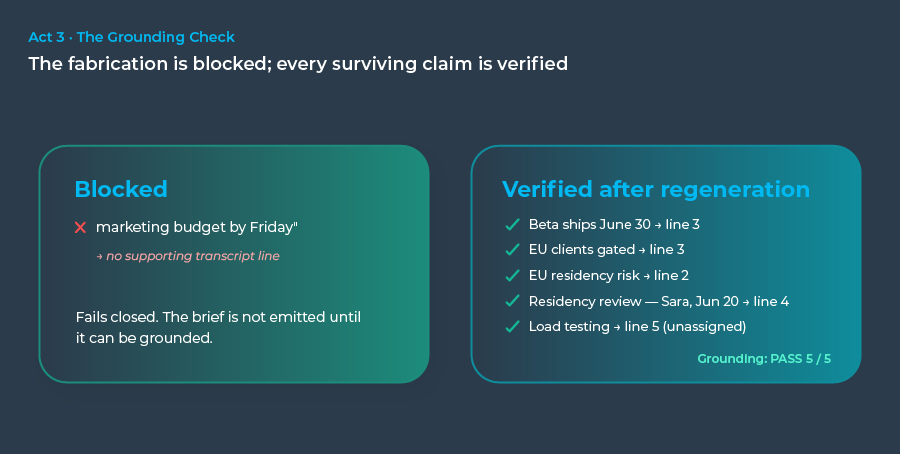
Act 3: the grounding check blocks the fabrication, then verifies every claim after regeneration
Run the same instruction against the same transcript again, this time with the Act 2 specification in force, and the outcome changes completely. The verifier checks the fabricated claim, “Marco to finalize the marketing budget by Friday,” against the transcript and finds no supporting line. Under the grounding rule that fails closed: the brief is not emitted until the claim is either grounded or removed. Every other item is checked the same way, line by line, and the grounding check now passes five of five. The load-testing task, instead of vanishing as it did in Act 1, is correctly flagged unassigned, because the transcript never names an owner for it.
The AI has not become more careful. The specification is doing the checking that careful reading used to do, and it does it the same way on every single run.
Act 4: The Living Specification
The fourth act is the one that tends to change minds. A single new rule is added to the specification, “Every action item MUST have a due date,” and not one line of implementation code is touched. The same verifier runs again.
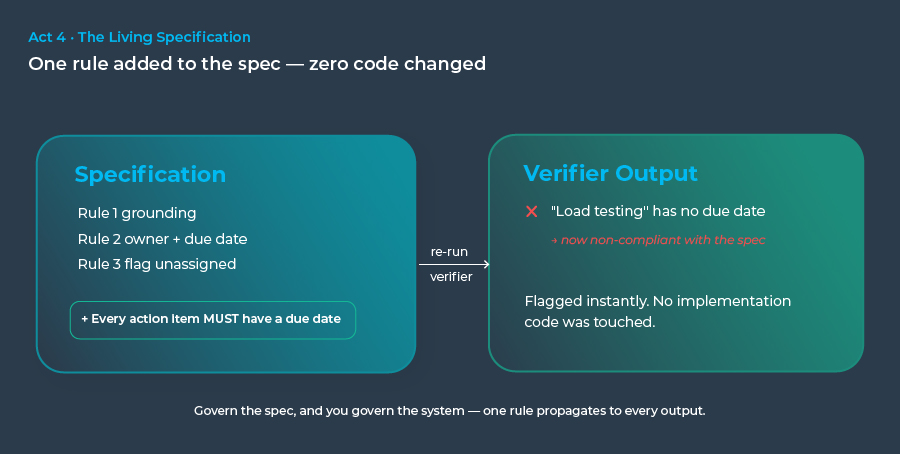
Act 4: one rule added to the spec instantly flags a non-compliant item. No code changes required
The governing principle: when you govern the spec, you govern the system. One rule, changed in one place, propagates instantly to every output the AI produces; no code change required.
Three Frameworks, Three Approaches
Three tooling frameworks have emerged to put these principles into practice. They differ in form factor, audience, and the particular bottleneck each is built to attack. A comparison table pulls them together at the end of this section; first, meet each one in turn.
OpenSpec: Review Before Code
OpenSpec starts from a single, disciplined rule: every change to the system must first be proposed as a change to the specification, reviewed by a human, and only then implemented by the agent. Current truth lives in one place; proposed change lives in another; and the boundary between them is a review gate. Nothing reaches code until a human has signed off on the intent. OpenSpec also keeps a project.md steering file, durable, project-wide conventions and context that every proposal is expected to respect, separate from the specs and changes that come and go.
Return to our meeting-notes assistant. Today it returns Summary, Decisions and Risks, but a reader still has to comb the transcript to find who owes what. So we open a change proposal, add-action-items, laid out exactly as OpenSpec prescribes. A proposal.md states why we are changing the system and what changes. A spec delta adds the new Action Items capability as SHALL statements: every item must be grounded in a transcript line, any task with no named owner must be flagged unassigned, and action-item recall must reach 0.90 on the labeled set. A tasks.md lists the work the agent will carry out. Crucially, a reviewer approves this proposal before the agent writes a single line: signing off on intent, not implementation.
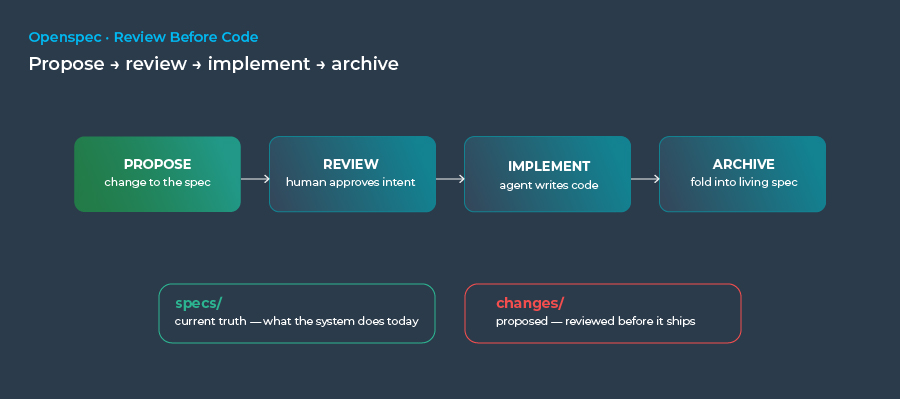
OpenSpec: propose → review → implement → archive, with a clean separation of current specs and proposed changes
From there the loop is mechanical and auditable. openspec validate confirms the proposal is well-formed; the agent implements against the approved change; openspec archive folds the delta into the living spec once it ships. And when we run it on a real transcript, the payoff is visible: the load-testing task, which nobody owned, is flagged UNASSIGNED; every decision and risk cites the exact source line it came from; the grounding check passes five of five. The audit trail, who agreed to this behavior and when, is not extra paperwork bolted on afterwards. It is the artifact itself.
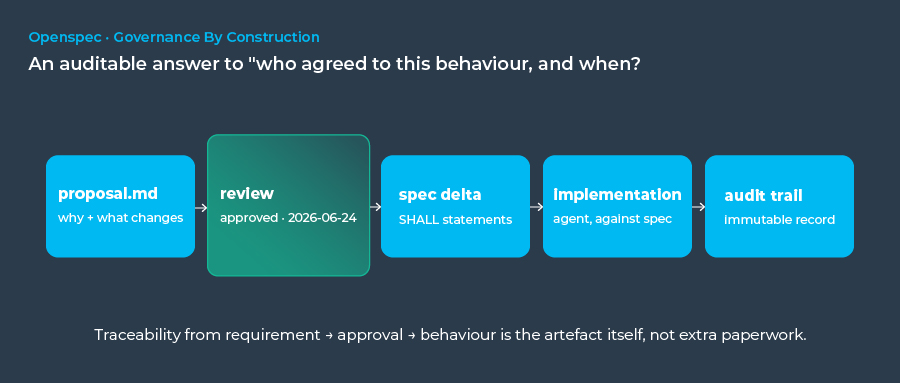
Traceability and governance by construction: an auditable answer to "who agreed to this behavior, and when?"
GitHub Spec-Kit
Spec-Kit takes the same principles and expresses them as a five-command workflow that deliberately separates WHAT the system should do from HOW it does it. It opens with a /constitution command, which lays down the project's non-negotiable principles and constraints in a constitution.md, a steering file every later command must respect. In our build, that separation is literal. A requirements file pins the obligations down as numbered, testable statements: R1 structured extraction, R2 grounded output, R3 action items with owner and due date, R4 robustness and a ten-second latency budget, R5 a machine-readable JSON contract, before any design exists. A design file then derives from those requirements, every component traced back to the requirement it satisfies, with the output schema treated as the single most important design decision. Only then does a tasks file split the work into agent-sized units, each tagged with the requirement it serves. WHAT is frozen and reviewed before HOW is ever discussed.
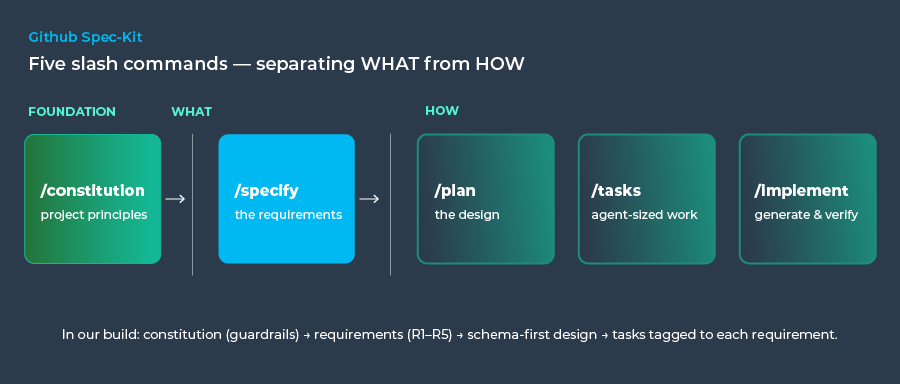
Spec-Kit: five slash commands, separating WHAT the system does from HOW it does it
Kiro
Kiro, an agentic IDE from AWS, pushes the same idea deepest into the tools. A feature begins life as a specification rather than a prompt, captured across three linked files: requirements, design and tasks, with requirements written in the EARS style: WHEN a transcript assigns a task to a named person, THEN each action item SHALL include an owner and due date; IF a task is mentioned with no owner, THEN it SHALL be flagged unassigned. Event-driven hooks keep those files and the code in lockstep, so the specification cannot quietly rot away from what actually ships. Same meeting-notes assistant, same obligations, expressed as a living, IDE-native artifact rather than a document filed off to the side. Alongside the feature-level spec, Kiro keeps steering files (product.md, tech.md and structure.md) that capture project-wide product intent, technical conventions and architectural structure, so every new feature inherits the same context automatically.
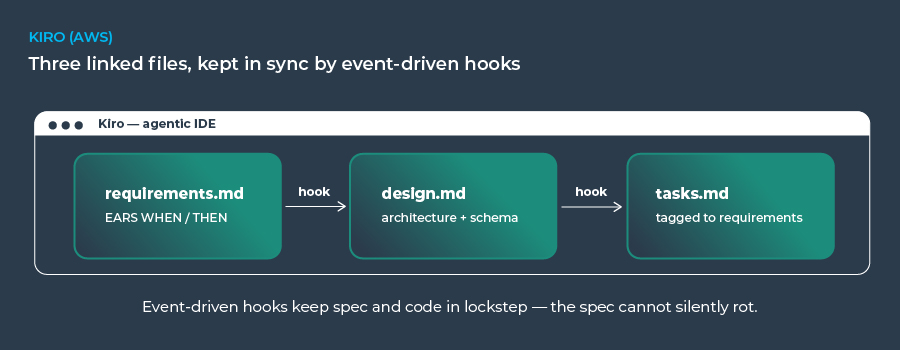
Kiro: three linked files kept in sync by event-driven hooks, built into the IDE
| Dimension | OpenSpec | Spec-Kit | Kiro (AWS) |
|---|---|---|---|
| Unit of work | Spec change proposal | Feature spec pipeline | Feature spec in IDE |
| Core files | specs/ + changes/ | spec / plan / tasks | requirements / design / tasks |
| Steering / context files | project.md | constitution.md | product.md, tech.md, structure.md |
| Form factor | Markdown + CLI | Slash commands + CLI | Agentic IDE |
| Requirements | SHALL + scenarios | FR-IDs + clarifications | EARS (WHEN/THEN) |
| Stands out for | Review-before-code, audit | WHAT/HOW separation | Spec-code sync, DX |
| Best fit | Governed, multi-tool teams | Greenfield features | IDE-centric teams |
AI SDLC
Why AI Systems Need a Different Kind of Software Lifecycle
Traditional software lifecycles were built for deterministic systems. Nearly every assumption baked into them (reproducible bugs, binary pass/fail tests, exact-equality assertions) quietly breaks the moment a probabilistic AI component enters the picture.
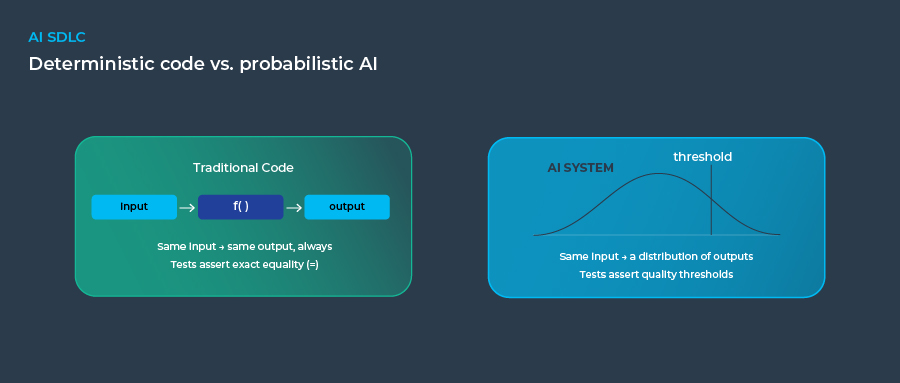
Deterministic code yields one output; probabilistic AI yields a distribution, measured by thresholds, not equality
TRADITIONAL SOFTWARE
| AI SYSTEMS
|
The Seven Specifications of an AI System
A complete AI system is not really a codebase; it is a composition of seven distinct specification types. Each can fail on its own, and each demands its own governance, versioning, and evaluation discipline. Neglect any one of them and that is precisely where the system will surprise you.
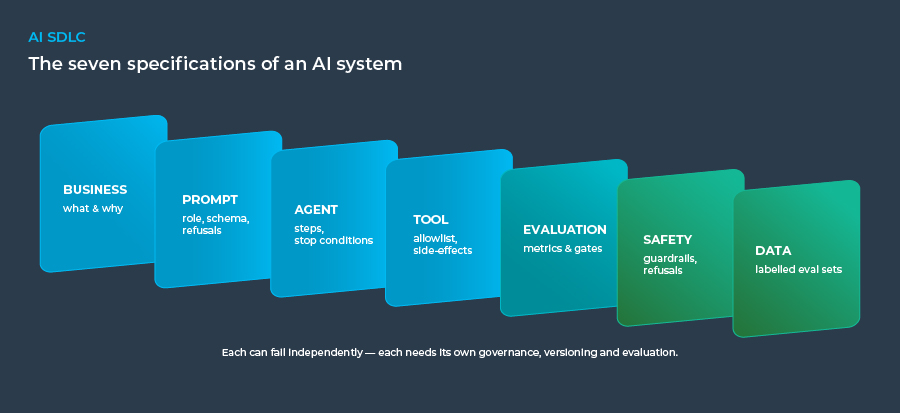
The seven specification types: every AI system requires all seven to be explicitly authored and governed
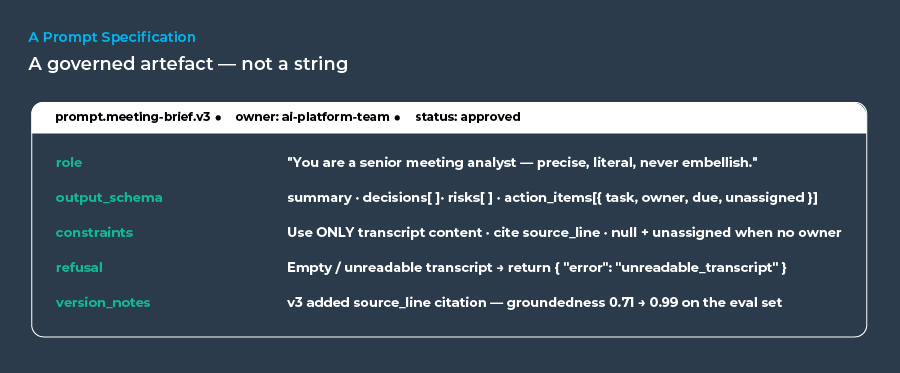
A prompt specification: versioned, with role, output schema, constraints and refusal rules, a governed artifact, not a string
The AI SDLC Lifecycle
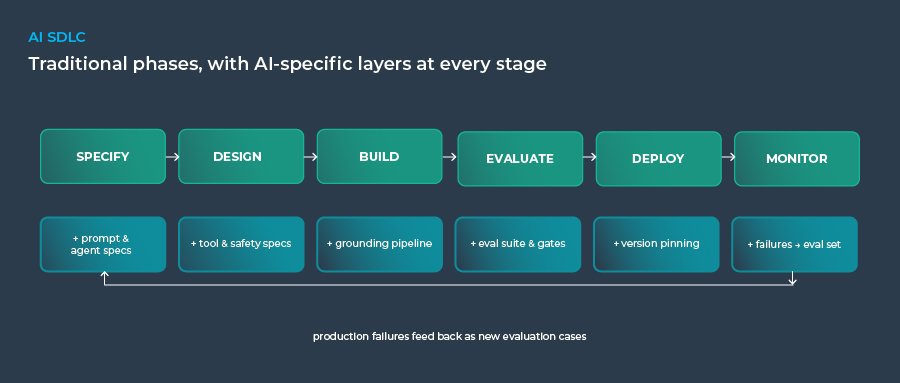
The AI SDLC lifecycle: traditional phases with new AI-specific layers at every stage
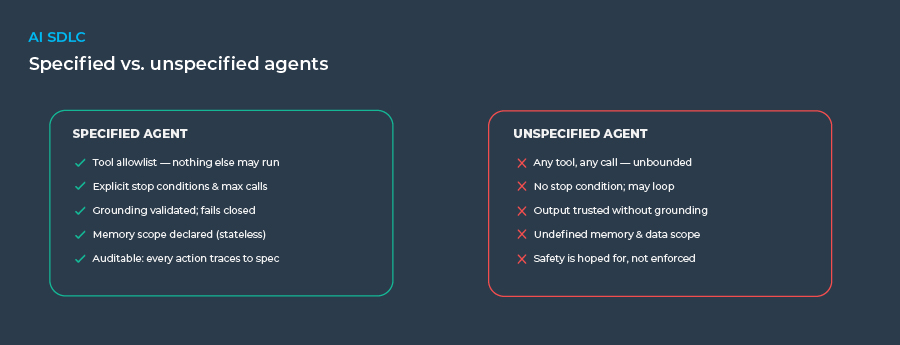
Specified vs. unspecified agents: governed, auditable systems versus systems where safety is hoped for, not enforced
EVALUATION-DRIVEN DEVELOPMENT
The Evaluation Suite is the Test Suite
In specification-driven AI development, the evaluation suite plays the exact structural role the test suite plays in traditional software: a change ships if and only if it clears every threshold in the evaluation specification. What differs is what is being measured: quality distributions, not boolean assertions.
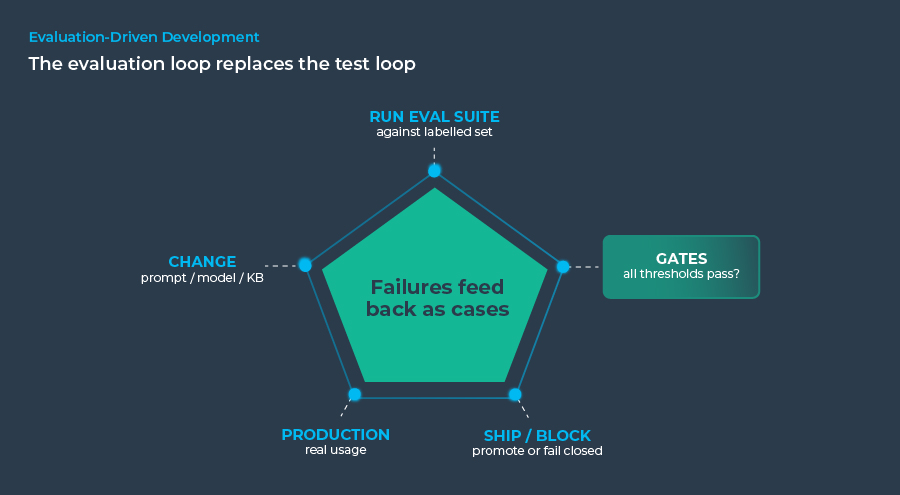
The evaluation loop replaces the traditional test loop for AI systems
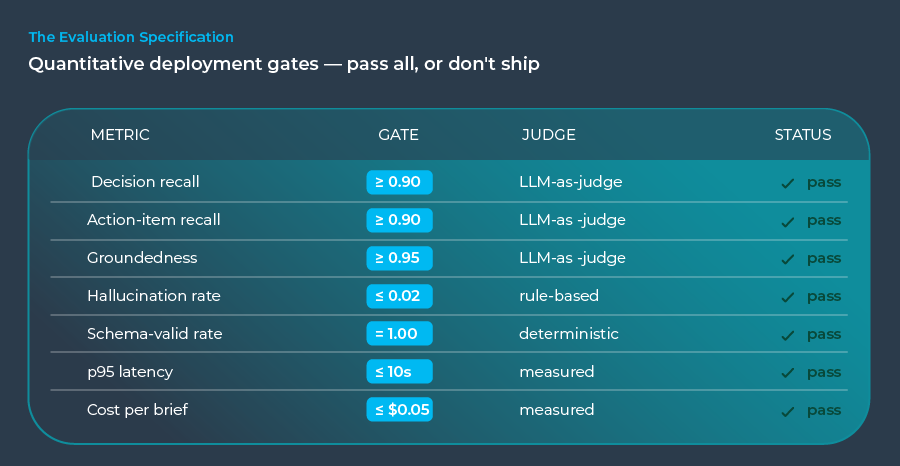
The evaluation specification: quantitative deployment gates that a version must clear before promotion
Each metric is scored by a judge: either deterministic (schema-valid, verified by parsing) or a calibrated probabilistic one (recall and groundedness, via LLM-as-judge against human-labeled references). The judge model and its prompt are pinned and recalibrated quarterly, so the ruler itself does not quietly drift. Every threshold is a deployment gate: a version is promotable to production only if all gates pass.
The feedback loop: production failures return as new evaluation cases. The suite grows with real-world failures rather than only the scenarios someone thought to imagine up front, which is how it stays honest over time.
END-TO-END IN PRACTICE
One System, From Vague Ask to Live Product
The most convincing evidence for specification-driven AI SDLC is to watch the whole thing run end to end: the same meeting-notes assistant, carried from a single vague business requirement through every lifecycle stage (specification, design, development, testing, deployment) with the specification governing each step along the way.
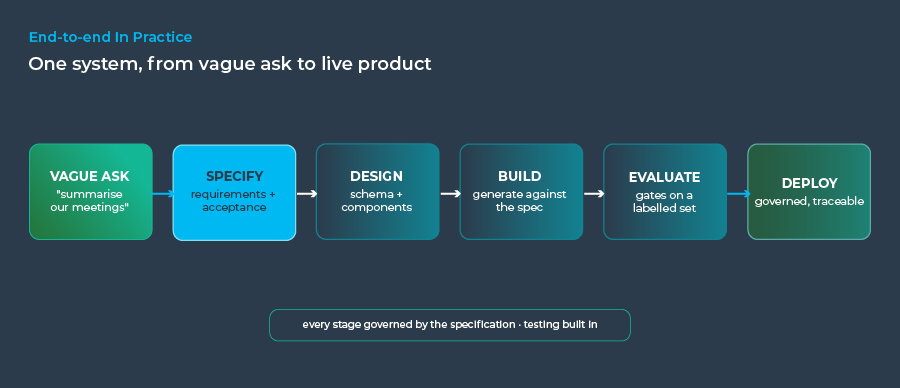
The full lifecycle executed end-to-end: every stage driven by AI, governed by the specification, with testing built in
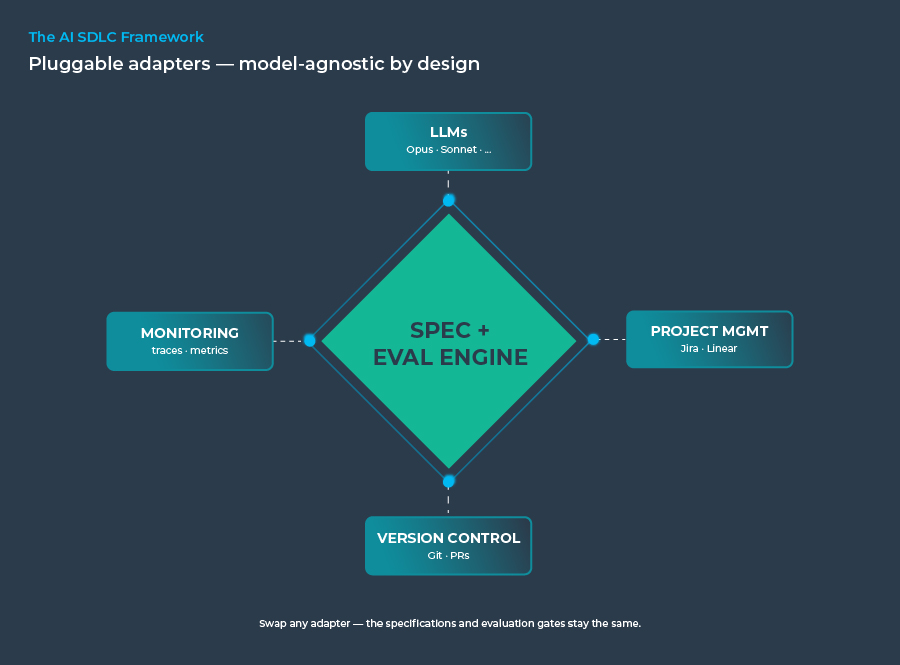
The AI SDLC framework: pluggable adapters for LLMs, monitoring, project management, and version control, model-agnostic by design
Under the hood, the framework's evaluation engine measures six independent dimensions (decision recall, action-item recall, risk recall, groundedness, hallucination rate, and unassigned-flag accuracy) each scored against a labeled test set, with the transcript itself serving as the source of truth for grounding.
IMPLICATIONS
What This Means for Engineering and Business Teams
For Engineering Teams
- Specifications are version-controlled artifacts in Git, with blame history, pull requests, and an audit trail of why the system behaves as it does
- Acceptance criteria must be defined before generation: "done" is a property of the spec, not of the output
- Evaluation suites replace test suites, measuring quality distributions against labeled datasets, not boolean assertions
- Executable grounding rules can block a build automatically, without human review of every AI output
- Prompt changes are specification changes, versioned, reviewed, and validated through the evaluation loop
- Agentic systems require explicit stop conditions, tool allowlists, and memory scope, or they run unbounded
For Product & Business Teams
- The most valuable skill is shifting from code authorship to specification authorship: precision of intent is the new competitive advantage
- Governance is built into the workflow by construction: every behavior change requires a reviewed proposal first
- Traceability from requirement to deployed behavior to audit trail is achievable, and increasingly required by regulators
- AI correctness is probabilistic, not binary: stakeholders set quality thresholds rather than expect deterministic pass/fail
- Evaluation datasets are a business asset: curated, grown with real-world failures, and governed like production data
From AI Experimentation to Enterprise-Scale AI Delivery
The pattern in all of this is hard to miss: organizations that govern their AI systems with real specification discipline ship more reliably, catch failures earlier, and end up with systems their compliance and leadership teams can actually trust. Closing the distance between AI's promise and production-ready delivery takes two things together: the right methodology and the right engineering partner.
01
AI Architecture & Spec Design
We design the full seven-specification stack — Business, Agent, Evaluation, Prompt, Tool, Safety — before implementation begins.
02
SDLC Implementation
We embed evaluation-driven development, grounding pipelines, and automated quality gates into your delivery workflow.
03
Governance & Traceability
We build the governance layer that gives compliance, legal and leadership the audit trail they need to trust AI output.
04
Evaluation Engineering
We design evaluation suites, labeled datasets, and quality thresholds that make AI correctness measurable.
05
Team Enablement
We train developers, product managers, and analysts to write specifications that AI agents can act on, closing the intent gap.
06
Agentic AI at Scale
We architect multi-agent systems with defined tool specs, memory policies, stop conditions, and safety guardrails.
Whether you are evaluating your first AI product or scaling a portfolio of agentic systems, Cybage brings the engineering rigor that turns AI potential into measurable business value. The teams that win the next decade will not be the ones that write code the fastest. They will be the ones that know, precisely, what to build, and can prove it.