
A 2024 Gartner survey says that 42% of procurement leaders now rank supply disruption as the single biggest threat to their future success. Annual losses linked to supply chain disruptions have crossed $184 billion, according to J.S. Held. At the same time, 85% of online shoppers say they would not reorder after a poor delivery experience. These numbers tell a story that most boardrooms have not fully absorbed yet.
Organizations have responded by investing in digital platforms, visibility tools, and resilience strategies. Yet despite these efforts, a fundamental problem remains: most supply chains are still reactive. They respond faster than before, but they continue to struggle to anticipate, adapt, and, most importantly, create an advantage from disruption.
Most organizations have achieved visibility. Far fewer have achieved adaptability.
Control towers can show where inventory is located. Dashboards can identify delays. Analytics can highlight risks. Yet when disruptions occur, decisions still depend on fragmented workflows, manual interventions, and disconnected planning cycles.
The challenge is no longer access to information. The challenge is converting intelligence into action at the speed required by today's markets.
So the real question is no longer "How do we recover faster?" It is "How do organizations come out stronger every time disruption hits?" This is where Supply Chain 5.0 enters the conversation, not as another buzzword, but as a necessary shift in how we think about value.
The Rise of Supply Chain 5.0
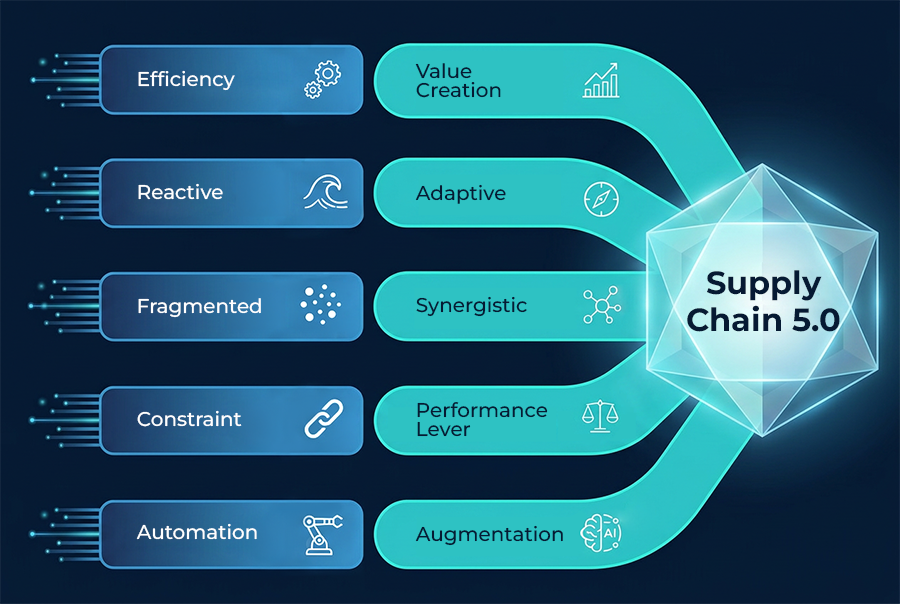
Supply Chain 5.0 is the evolution of digitally connected supply chains into intelligent, adaptive ecosystems. It combines AI, human expertise, sustainability, and real-time decision-making to create a competitive advantage.
Unlike previous generations that focused primarily on efficiency, visibility, or automation, Supply Chain 5.0 focuses on continuous adaptation and value creation in an unpredictable world.
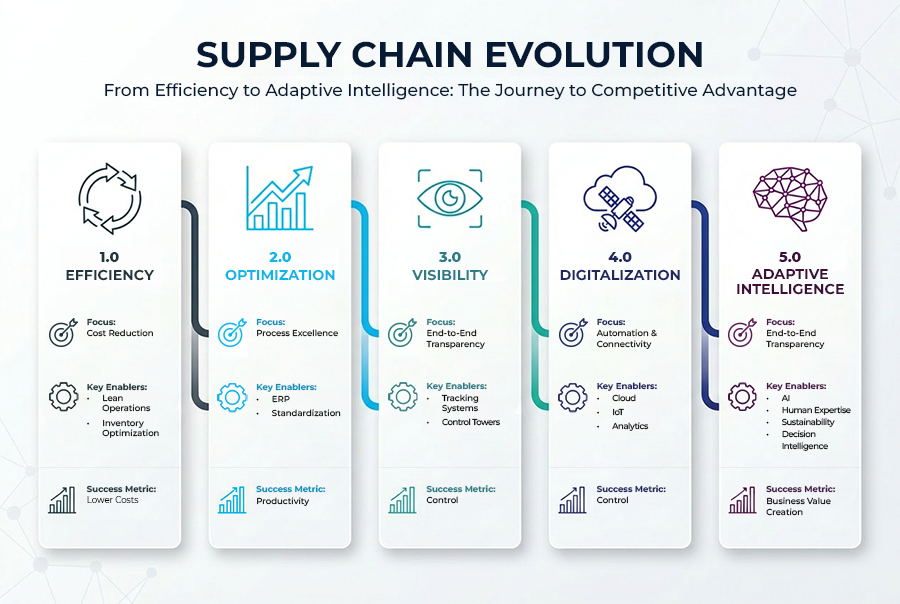
As the evolution of supply chains demonstrates, each generation solved a different business challenge. Supply Chain 5.0 builds on these foundations but shifts the focus toward adaptability, decision intelligence, and long-term value creation.
From Efficiency to Value Creation
For years, supply chains were optimized for efficiency, lean inventories, cost control, and predictable flows. That model worked in a relatively stable world. Today's environment is different. Demand volatility, geopolitical risks, and sustainability pressures have made efficiency alone insufficient.
In response, many organizations have focused on resilience, adding buffers, diversifying suppliers, and improving visibility. While necessary, this approach introduces trade-offs: higher working capital, increased complexity, and slower decision cycles. Supply Chain 5.0 moves beyond this trade-off. It repositions the supply chain from a cost center to a strategic value driver, one that simultaneously enables growth, adaptability, and sustainability.
The Real Bottleneck: Decision Latency
Despite increased visibility, most organizations face a critical constraint: decision latency. Data is available, but decisions are delayed. Insights exist, but execution is fragmented. Systems inform, but do not adapt. This gap between insight and action is where value is lost.
For example, a retailer may identify a supplier's delay within minutes, but approvals for alternate sourcing can still take days. A logistics provider may detect route disruptions in real time, yet operational adjustments often remain dependent on manual coordination. The result is a decision problem.
In an environment defined by continuous disruption, organizations must move from static planning cycles to continuous, intelligence-driven decision loops that enable faster and better decisions.
Supply Chain 5.0 in Action
Supply Chain 5.0 is not simply the next stage of digital transformation. It represents a shift from managing supply chains as operational systems to managing them as adaptive decision ecosystems that continuously decide and respond.
The principles of Supply Chain 5.0 are already being applied across industries where resilience and decision quality directly impact business performance.
Healthcare
AI-enabled cold chain monitoring predicts temperature excursions before products are compromised, helping healthcare organizations protect critical inventory and improve patient outcomes.
Retail
Demand sensing and inventory intelligence continuously adjust replenishment decisions based on real-time consumer behavior, reducing stockouts and improving customer satisfaction.
Logistics
Route optimization engines dynamically respond to weather events, traffic conditions, and capacity constraints to improve delivery performance and operational efficiency.
Manufacturing
Digital twin supply chain models simulate production and sourcing scenarios before disruptions occur, allowing leaders to evaluate trade-offs and act proactively.
While these examples demonstrate how organizations are improving speed, Supply Chain 5.0 is equally redefining how businesses approach sustainability.
Sustainability
A common misconception is that sustainability comes at the cost of performance. In reality, when embedded correctly, it becomes a driver of efficiency and long-term value.
Supply Chain 5.0 integrates sustainability directly into decision-making:
- Network optimization considers carbon alongside cost
- Supplier strategies incorporate resilience and ESG performance
- Demand planning aligns with waste reduction and lifecycle efficiency
This is where planet and profit stop competing and start reinforcing each other.
A Practical Starting Point
Transitioning to Supply Chain 5.0 does not require a complete transformation overnight. It begins with focused, high-impact shifts:
- Identify where decision latency impacts performance the most
- Integrate data across planning, execution, and external ecosystems
- Embed intelligence and AI in supply chain workflows, not just dashboards
- Align sustainability with core operational KPIs
- Invest in people and decision-making capabilities, not just platforms
The Question Every Leader Should Be Asking
Supply chains have evolved from operational backbones to strategic differentiators. The question is no longer whether your supply chain is efficient. The real question is: is it designed to create advantage in an unpredictable world?
Organizations that continue to operate with traditional models risk falling behind, not because they lack technology, but because they lack adaptability. Those that embrace Supply Chain 5.0 will build systems that do more than respond to disruption. They will learn and improve through it. In the years ahead, the winners will not be those who withstand disruption best. They will be those who use it to outperform.
At Cybage, we help organizations bridge the gap between visibility and intelligent action by integrating data, AI, analytics, and operational workflows into connected decision ecosystems. The goal is not simply to build resilient supply chains, but to create adaptive supply chains that continuously learn, respond, and generate business value.
Authored by
Ravi Sharma
Presales Head, Supply Chain & Logistics, Cybage