

Healthcare is changing fast. Even as new treatments and technologies emerge, documenting everything is taking up more of clinicians’ time. Complicated documentation comes from disconnected systems, strict compliance rules, and inefficient processes. Tasks that used to be simple now take so long that doctors and nurses spend almost 35 to 50 percent of their time on documentation, sometimes even more than with patients. This increase is largely driven by stringent billing requirements and legal defensibility, which demand more granular data than ever before. Additionally, the transition to Electronic Health Record (EHR) interfaces has prioritized administrative data collection over actual clinical workflow efficiency. This change is causing burnout, making jobs less satisfying.
At Cybage, we see this as more than a clinical issue; it is also an engineering and workflow challenge. To fix it, we need to rethink how clinical data is collected, organized, and used.
AI medical scribes are becoming a strong answer to this problem. Using speech recognition and natural language processing (NLP) help turn clinical conversations into organized medical records in real time. This change makes documentation less of a burden and more of a tool for better care.
Integrating AI Scribes into the Healthcare Ecosystem
Today’s medical care takes place in many settings, including hospitals, specialty clinics, telehealth, and remote care. AI scribes work best as part of the larger Healthcare and Life Sciences ecosystem. Instead of being separate tools, they fit into connected digital healthcare platforms.
AI scribes enable real-time documentation during both in-person and virtual visits, ensuring records remain consistent no matter where care is provided.
They help not just doctors, but also nurses, care managers, and other health professionals, especially in long-term care where tracking data over time is important. In addition to documentation, these transcriptions help call centers by turning conversations between agents and patients, members, or providers into clear text summaries. Organizations can use these summaries to analyze sentiment, improve caller experience, make call center processes more efficient, and build a stronger knowledge base.
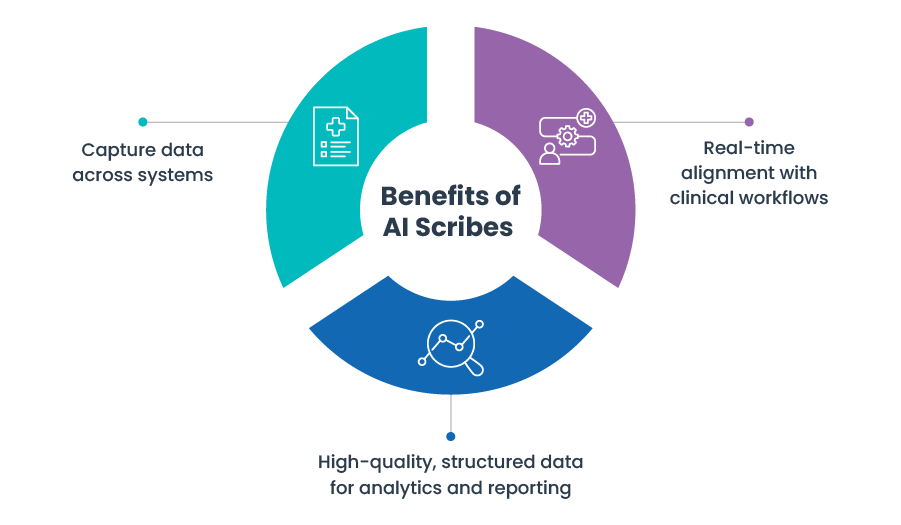
At Cybage, we build cloud-based healthcare platforms that work well together and are centered on AI. By connecting AI scribes with EHR and EMR systems, telehealth solutions, and analytics, we make it possible to:
How Cybage-Enabled AI Scribes Reduce Burnout
Reducing clinician burnout takes more than automation alone. Smarter workflows make a real difference. Cybage’s AI scribes address the main causes of documentation fatigue and delivers measurable outcomes:
- Automated Clinical Report Generation: Patient conversations are captured and turned into clear clinical summaries on the spot, so clinicians spend far less time on manual paperwork.
- Advanced Better Patient Interactions: When clinicians aren’t buried in documentation, they can give patients their full attention, leading to more meaningful conversations and a better overall experience.
- Smoother Medical Workflows: Getting notes done the same day means care teams aren’t spending hours of their day documenting. They can make faster decisions and stay in sync without things slipping through the cracks.
- More Accurate Records, Fewer Compliance Headaches: Capturing information consistently helps cut down on mistakes and makes it easier to stay on top of regulatory requirements.
- Human-in-the-Loop Governance for Compliance: AI-generated clinical content goes through a built-in review step, where clinicians or business users validate and approve outputs before submission. This ensures accuracy, maintains human oversight, and supports compliance with HIPAA and PHI standards.
- Less Administrative Burden: When clinicians aren’t taking work home just to catch up on notes, they can have their leisure time.
- Works Across Telehealth and In-Person Care: Whether a visit is over video or in the clinic, the quality of documentation remains the same.
- Insights That Actually Drive Action: When data is well-structured, it becomes a lot easier to spot trends, catch risks early, and make decisions based on what’s really happening, not just gut instinct.
- Inclusive, Multilingual Care Support: Accurate documentation across languages and backgrounds helps ensure more patients receive the quality care they deserve.
- Better Billing, Stronger Revenue: When documentation is accurate, coding becomes cleaner and billing runs more smoothly.
The Future of AI Clinical Documentation
AI clinical documentation has come a long way from just capturing what’s said in a room. The next generation of AI scribes is shaping up to be something clinicians can genuinely rely on, capable of:
- Pulling up the right patient history exactly when it’s needed
- Suggesting care pathways and next steps backed by real clinical evidence
- Catching potential risks and unusual patterns before they have a chance to escalate
As artificial intelligence services keep advancing, documentation doesn’t feel like something clinicians have to do after the visit is over; it’ll simply happen as part of the care itself.
That said, getting there the right way matters just as much as getting there fast. Patient data privacy, regulatory compliance, and keeping humans in the loop aren’t optional; they’re the foundation. Clinicians and patients alike will only trust AI if it’s transparent and consistently held to a high standard.
At Cybage, we’re building this future with responsible AI and strong engineering, helping organizations create care models that work better and keep clinicians where they belong: at the center.
Explore how Cybage’s healthcare IT solutions are simplifying clinical documentation and enabling smarter, AI-driven care.