

Retail has always been a geography game. What has changed, fundamentally and irreversibly, is how proximity gets activated. Hyperlocal retail today is not simply about being close to the consumer. It is about understanding intent and fulfilling demand within a compressed window of time, typically within a one-to-five-kilometer radius, powered by digital platforms that connect buyers, inventory, and delivery agents in real time.
Hyperlocal is no longer just about speed. It is about building hyper-relevant, sustainable, and profitable local ecosystems, ones that run on advanced technology and intelligent infrastructure.
Why Hyperlocal, Why Now?
Rising urban density across North America, Europe, Asia-Pacific, and Latin America, and a mobile-first shift in shopping behavior are reshaping how consumers discover and receive products. Hyperlocal retailing addresses rising consumer demands for instant gratification, convenience, and relevance in categories like groceries, essentials, and daily needs.
Hyperlocal retailing has evolved from an experiment into a core strategic lever for retailers. According to Fortune Business Insights, the global hyperlocal services market is expected to expand from roughly USD 4,462.57 billion in 2026 to USD 12,546.94 billion by 2034, at a CAGR of 13.79%. Deloitte’s 2026 Global Retail Industry Outlook emphasizes that value-seeking consumers, AI-driven commerce, and resilient supply chains are reshaping priorities, with 96% of retail executives expecting revenue growth despite economic pressures.
In our experience supporting global retailers, advanced IT solutions, such as real-time data platforms and intelligent automation, are essential to turning neighborhood proximity into measurable profitability and long-term competitive advantage.
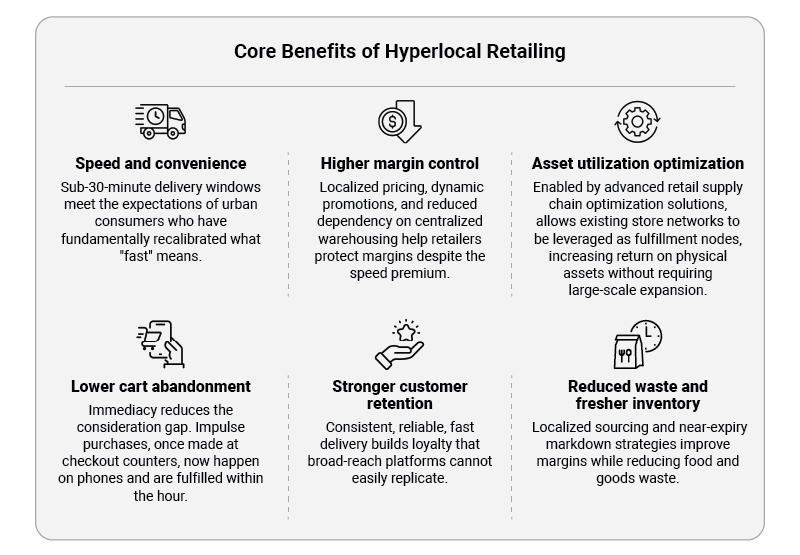
Core Benefits of Hyperlocal Retailing
Hyperlocal retail delivers advantages that traditional e-commerce and large-format retail struggle to match:
Key Operational Challenges
The hyperlocal model carries structural tensions that operators must actively manage:
- Unit economics under pressure - Speed costs money. More riders, hyperlocal stock positioning, and platform costs compress margins, particularly at lower order volumes.
- Last-mile complexity - Urban congestion, inconsistent address data, and rider availability create delivery reliability risks that directly impact customer experience.
- Data ownership trade-offs - Retailers using third-party platforms gain demand access but surrender customer data and pricing control, limiting their ability to build direct relationships.
- Sustainability of gig work - The pay, security, and working conditions of delivery agents remain a live and unresolved debate, with regulatory pressure increasing across markets.
- Infrastructure investment - Building or retrofitting dark stores and micro-fulfillment centers requires significant upfront capital, and getting the location strategy wrong is costly.
Infrastructure Models for Hyperlocal Retail
Hyperlocal infrastructure is not one-size-fits-all—retailers must choose the right mix of store-led, dark store, and network-driven models based on category, density, and customer promise. The winners will be those who can orchestrate these models intelligently.
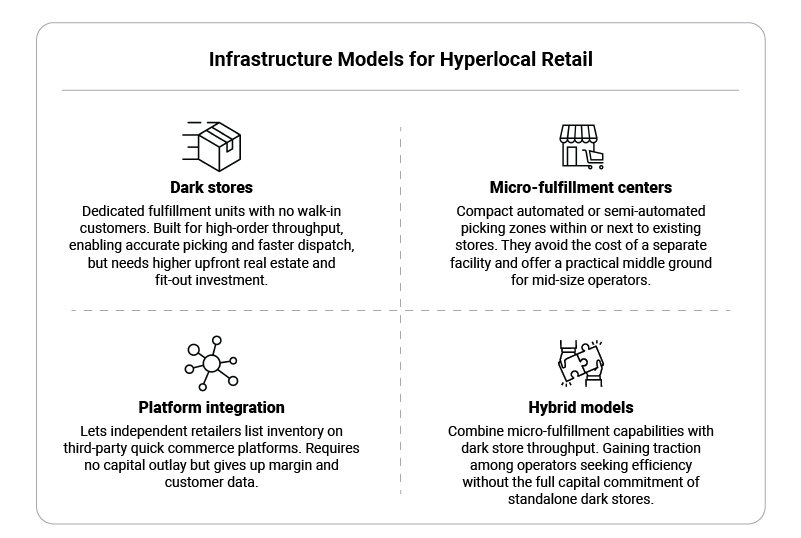
Whichever model a retailer selects, choosing the right fit depends on order volume, category mix, and how much of the customer relationship they want to own.
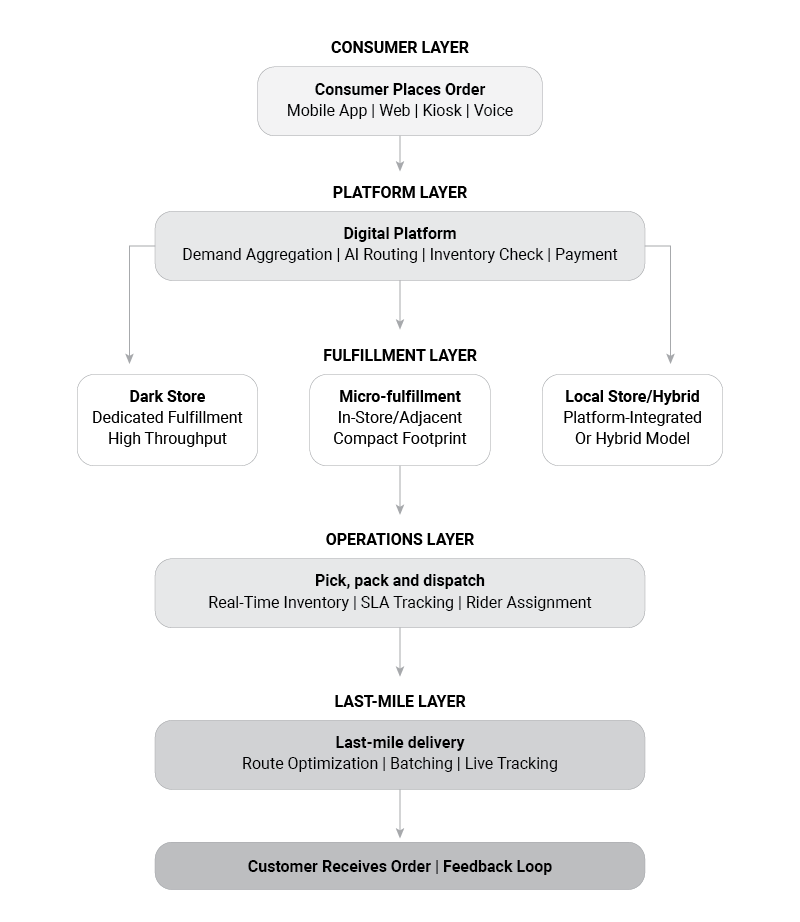
Below is a visual representation of how a hyperlocal delivery ecosystem operates end-to-end, from demand signal to doorstep:
Technology Enablers: The IT Backbone
The backbone of effective hyperlocal retail lies in AI-powered forecasting and analytics, tools that translate neighborhood-level signals (weather, events, foot traffic, and consumer behavior) into precise demand intelligence. For instance, a gym-adjacent zone shows distinct protein supplement demand patterns. A family residential area sees infant care spikes on weekday mornings. This intelligence powers smarter inventory placement, real-time dynamic pricing, and personalization at scale. Gartner projects that by 2026, 40% of enterprise applications will incorporate task-specific AI agents, many of which will directly influence retail supply chain visibility and hyperlocal operations.
IoT sensors, edge computing, and geofencing technologies deliver real-time inventory visibility and low-latency responsiveness critical to meeting demanding delivery of SLAs. Unified commerce platforms, forming the backbone of omnichannel retail solutions for businesses, orchestrate seamlessly across online, in-store, and last-mile delivery channels, while AI-driven routing and intelligent automation elevate both efficiency and sustainability.
Deloitte’s 2026 outlook emphasizes that AI-led agility will define retail success. The firm reports that 50%+ Retail leaders expect to deploy agentic AI within the next couple of years, treating automation as an essential operational infrastructure. As retail transformation specialists, we view these technologies not as optional enhancements but as foundational enablers that allow retailers to pilot hyperlocal models quickly and scale them profitably with measurable ROI.
Cybage in Action
Cybage partnered with a Japan-based B2B2C marketplace to address last-mile delivery challenges across remote and non-traditional locations. The client needed a scalable, technology-led approach to ensure reliable, low-touch deliveries while improving accessibility for underserved and elderly users. We implemented a cloud-based, autonomous drone-enabled delivery ecosystem integrated with mobile commerce and order management systems, enabling seamless operations and real-time coordination. The solution expanded delivery reach to hard-to-access areas, improved operational efficiency, and established a future-ready logistics foundation.
Read our full case study here.
Future Outlook: Hyperlocal in an AI-Native World
The next phase of hyperlocal retail will be defined by Agentic AI and sustainability-focused operations. Retailers should conduct a comprehensive hyperlocal maturity assessment of their ecosystem and prioritize modular, scalable architectures needed for real-time decision making and future-proof operations.
In a world where consumer patience is measured in minutes, hyperlocal retail is not a niche strategy; it is the operating model for urban commerce. Retailers who build the technology infrastructure today will be best placed to lead as this model matures.