
The expanding role of AI workloads has reshaped the way enterprises think about data platforms. Modern AI model training, inference, and agent-based systems rely on cloud-scale data access, making cloud-native platforms the natural foundation.
Enterprises are no longer re-architecting platforms just to refresh infrastructure. The driving force is AI consumption patterns and the unification of distributed data across applications, devices, partners, and SaaS systems. This makes the cloud the inevitable convergence point for enterprise data, enabling organizations to unify diverse sources under a single, scalable architecture, often accelerated through Cloud Data Migrations.
Unifying Enterprise Data with Cloud-Native Platforms
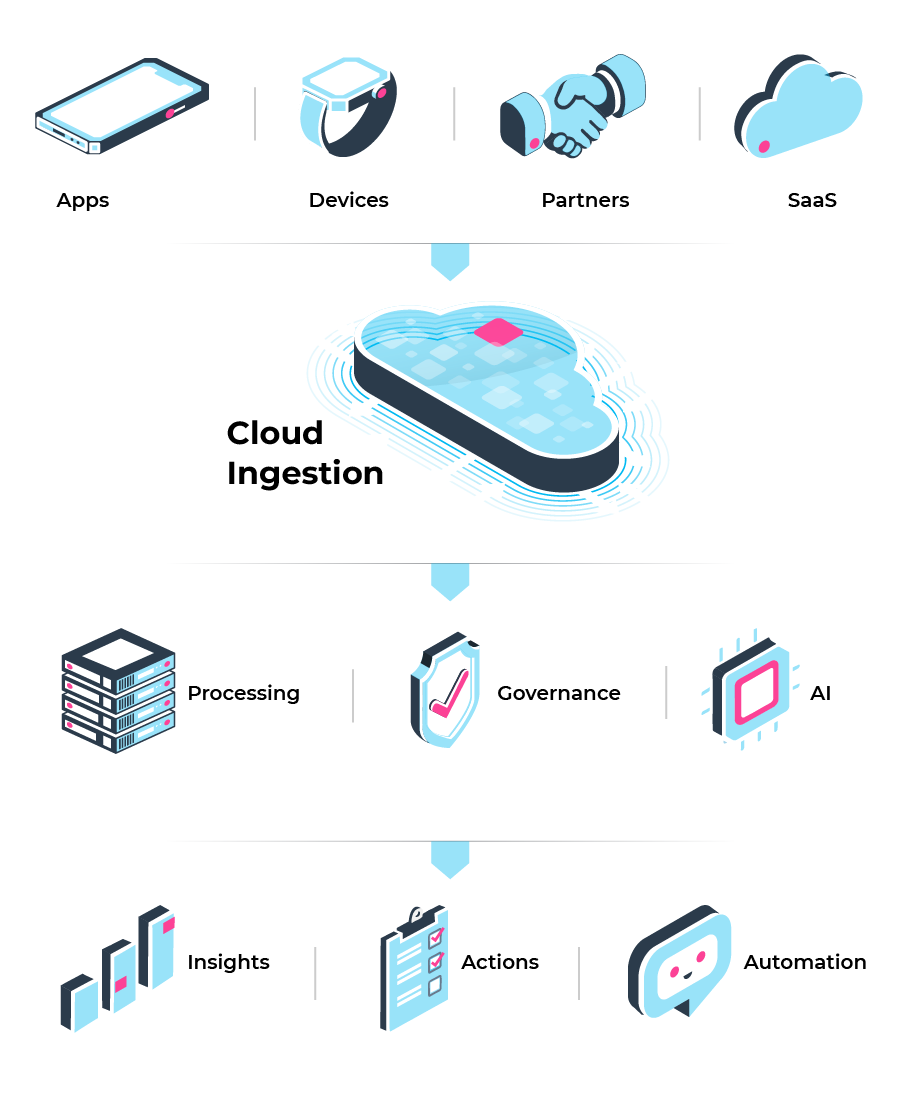
By serving as the central hub for data from apps, devices, partners, and SaaS systems, cloud platforms create a unified layer where enterprise data converges. This unified layer standardizes how data is ingested across the enterprise, regardless of source or format. Eliminating silos and reducing latency, cloud-native data platforms accelerate actionable insights and decision-making, turning raw data into a strategic asset for intelligent enterprises.
The cloud has become an environment where enterprise data is accessed, processed, and governed in real time. It provides a shared foundation for analytics, AI models, and operational systems, ensuring data can move reliably from source to insight while remaining observable and secure at scale.
Enterprise Data Flow Through a Cloud-Native Platform
Why Enterprises Are Re-Architecting Data Platforms
As enterprises unify data from diverse sources, legacy systems struggle to deliver the speed, reliability, and integration required for continuous insights and proactive decision-making. Re-architecting data platforms allows organizations to enable consistent access to high-quality data across distributed environments.
Achieving this level of performance and resilience requires a robust architectural DNA designed specifically for AI-native data consumption.
Architectural DNA Required to Support AI-Native Data Consumption
Cloud-native platforms achieve the elastic scaling, data volatility, and high-availability demands of AI-native workloads through modular, service-oriented designs that separate compute from storage and provide self-healing, automated infrastructure. These capabilities ensure that AI models can access the right data at the right time, pipelines remain resilient under load, and experimentation cycles are accelerated without manual intervention, often built alongside Cloud-Native Application Development Services.
Key capabilities include:
- Decoupled compute and storage: Allows independent scaling of workloads, so AI training and inference can expand without bottlenecks.
- Containerized, microservices-based data services: Provides modularity and portability, enabling hybrid and multi-cloud deployments with minimal disruption.
- Built-in scalability and resilience: Ensures high availability, fault tolerance, and consistent performance under fluctuating AI demands.
- Infrastructure-as-code foundations: Automates deployment and management of complex platforms, reducing manual errors and speeding up experimentation.
- Elastic orchestration and monitoring: Uses Kubernetes or similar frameworks to dynamically schedule resources and maintain observability across distributed workloads.
This architectural DNA forms the backbone that allows cloud-native platforms to support AI workloads reliably, providing the foundation for governance, operational excellence, and real-time intelligence.
With these architectural foundations in place, enterprises can turn their focus to governing and operating data platforms at scale.
Governing and Operating Data Platforms
Effective governance ensures trust, compliance, and reproducibility across distributed environments. Metadata-driven governance tracks lineage, enables observability, and enforces security and compliance policies, while operational practices maintain platform reliability.
Key governance practices include:
- Lineage tracking: Monitors data origin, movement, and transformations.
- Observability: Provides real-time monitoring of pipelines and AI workloads.
- Security & compliance: Ensures encryption, access control, and adherence to regulatory requirements.
- Data product management: Manages versions, dependencies, and lifecycle of datasets.
- Reproducibility: Guarantees consistent results for analytics and AI experiments.
Together, these practices give enterprises the control and visibility needed to operate complex, distributed data platforms confidently.
Streaming, Events, and Real-Time Data as Native Inputs to AI Systems
AI and analytics increasingly demand high-velocity, real-time data. Streaming and event-driven pipelines have become primary sources of intelligence, complementing traditional batch processing. By integrating batch, streaming, and operational data into a unified platform, enterprises can generate real-time insights that drive proactive decision-making.
Processing events in motion allows AI systems to respond immediately, detect anomalies, and enable predictive actions. This continuous flow of information empowers organizations to stay ahead of market changes.
Engineering Data Platforms for Continuous Intelligence
Cloud-native data platforms are not a one-time initiative; they are continuously evolving foundations for enterprise intelligence. By engineering platforms that scale alongside AI workloads and business ambitions, organizations can build resilient and intelligent systems.
In practice, this requires partners with deep platform engineering expertise. At Cybage, we design and operate cloud-native data platforms that support real-time analytics, AI workloads, and evolving enterprise needs. Drawing on experience across AWS, Google Cloud, and Azure, we apply modular architectures, automation, and scalable data services through Cloud Consulting Services to help organizations build efficient data foundations.
Our focus is on enabling reliable data access, operational stability, and continuous intelligence across complex enterprise environments.
Explore Cybage case studies and insights to understand our work in delivering scalable, enterprise-grade technology solutions: Resource Center: Cybage
Connect with us to re-architect your data platform for scalable AI and operational resilience.