
As software delivery speeds up and infrastructure becomes more complex, teams are constantly seeking ways to simplify deployments without sacrificing control. This is where GitOps comes into play. But what is GitOps?
GitOps is a modern DevOps practice that manages application code and infrastructure through Git, ensuring consistency, version control, and automated deployments. Instead of manually managing deployments or relying on scattered scripts, teams define everything declaratively and let automated systems ensure the live environment always matches what’s stored in Git.
At its core, GitOps brings together familiar DevOps principles: automation, collaboration, and continuous delivery, while adding a powerful layer of consistency and traceability. As organizations move deeper into cloud-native ecosystems, GitOps is quickly becoming more than a trend; it’s a necessity.
Key Differences: GitOps vs Traditional DevOps
While GitOps evolved from DevOps, key differences set them apart. DevOps often manages infrastructure changes via scripts or manual steps, while GitOps stores all configurations in Git and relies on automation for deployments. In DevOps, changes may occur outside version control, whereas in GitOps, every change is tracked in Git, enabling detailed audit trails and greater consistency across environments.
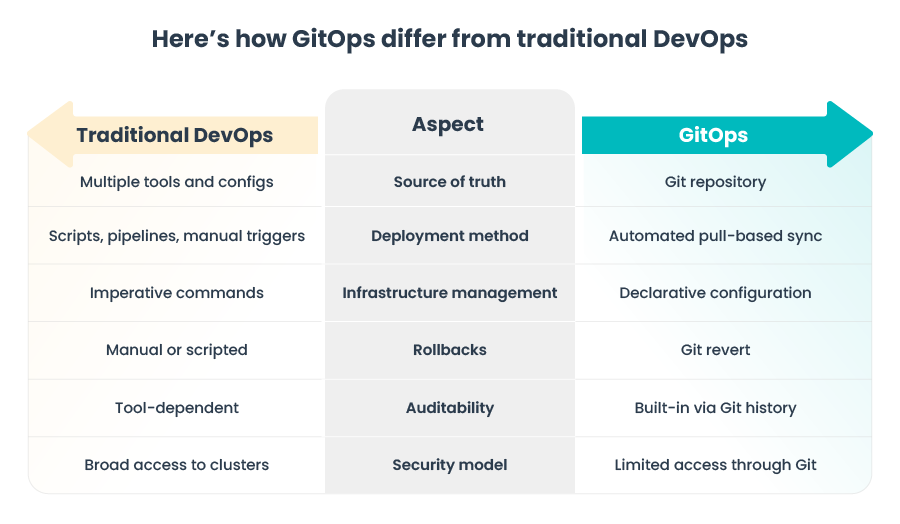
These differences highlight why GitOps is not a replacement for DevOps, but rather an evolution that brings more structure and reliability to cloud operations.
Why GitOps Is Vital for Cloud-Native CI/CD Processes
Cloud-native environments rely heavily on containers, Kubernetes, and microservices—technologies that change rapidly and scale unpredictably. Traditional cloud-native CI/CD pipelines often struggle to maintain consistency across environments, especially as deployment frequency increases.
GitOps simplifies this challenge by making Git the control plane. When a change is committed, automated agents continuously compare the desired state in Git with the actual state in the cluster. If there is drift, the system automatically corrects it.
In short, GitOps aligns naturally with the speed and complexity of cloud-native development.
How Enterprises Can Implement GitOps to Modernize Their Operations
For enterprises, adopting GitOps doesn’t require an overnight transformation. Most organizations begin by identifying non-critical workloads and moving deployment definitions into Git repositories. Tools such as Argo CD or Flux are then introduced to manage synchronization between Git and runtime environments.
A successful enterprise GitOps model includes:
- Standardized repository structures
- Environment-specific configuration management
- Clearly defined approval workflows
- Integration with existing CI/CD and security tooling
At Cybage, GitOps implementations are typically aligned with enterprise change-management processes, ensuring that governance, compliance, and operational visibility remain intact while delivery velocity improves.
By scaling GitOps incrementally across teams, organizations modernize operations without disrupting business continuity.
What Core Business Challenges Does GitOps Help Organizations Address?
In large enterprises, operational complexity is often the biggest bottleneck, not technology itself. Traditional operations depend on manual steps, environment-specific scripts, ticket-driven changes, and direct access to production systems. As the scale increases, this model becomes fragile.
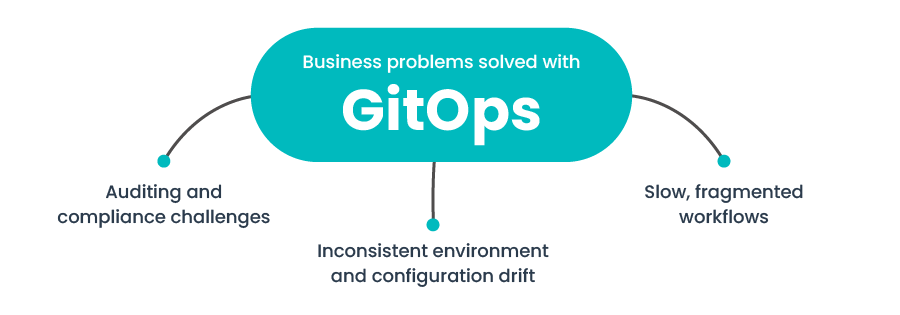
Auditing and compliance challenges: In traditional operations, tracking who changed what and when requires correlating logs across multiple tools. GitOps centralizes all changes in Git, providing built-in audit trails through commits, pull requests, and approval histories.
Environment inconsistency and configuration drift: Differences between development, staging, and production environments are a common operational risk. GitOps continuously reconciles live environments with the desired state defined in Git, automatically detecting and correcting drift.
Slow and fragmented operational workflows: Conventional operations depend on tickets, manual handoffs, and scheduled release windows. GitOps replaces this with version-controlled workflows where infrastructure and operational changes follow the same predictable, automated process as application code delivery.
In Cybage’s enterprise engagements, the real transformation begins when organizations start using GitOps not only for deployments but also for day-to-day operational needs—configuration changes, scaling rules, patching, and disaster recovery. At that point, GitOps becomes a revolution in how operations function.
Best Practices for Implementing GitOps
For GitOps to succeed at enterprise scale, it must align with business processes rather than bypass them.
- Treat Git as the single source of truth: No manual production changes—ever. This is foundational for auditability and trust.
- Design enterprise-grade workflows: Pull requests, approvals, automated validations, and policy checks should mirror organizational governance models.
- Standardize operations: GitOps replaces ad-hoc scripts with reusable templates, shared pipelines, and consistent deployment patterns.
- Enforce controlled access: Restrict production access through Git permissions instead of cluster credentials.
- Adopt incrementally: Begin with non-production workloads before expanding across mission-critical systems.
When implemented this way, GitOps becomes embedded as an enterprise operational practice, not just another DevOps tool.
Future of GitOps
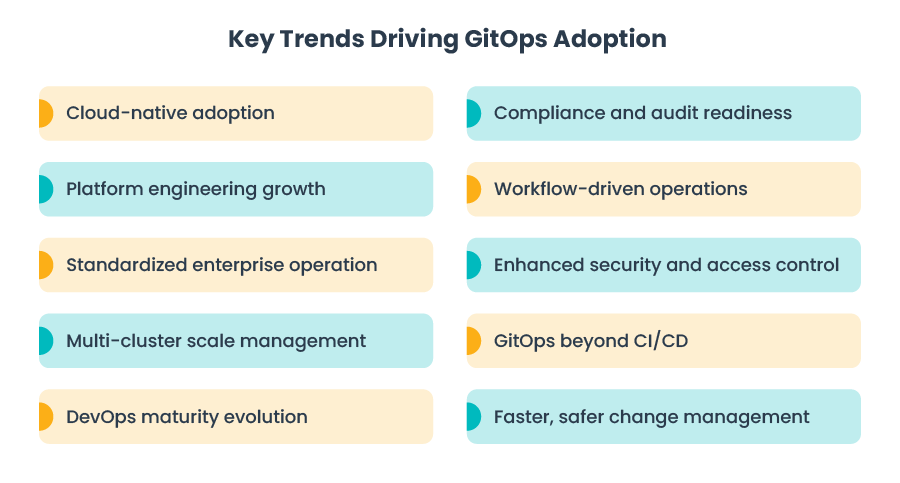
Looking ahead, GitOps will evolve alongside AI-driven automation, policy-as-code frameworks, and advanced observability platforms. Deeper integration with security scanning, cost optimization, and compliance engines will further strengthen its enterprise relevance.
As organizations continue their cloud-native journey, GitOps will shift from an optional enhancement to a foundational operating model. By unifying infrastructure, application delivery, and governance into a single workflow, GitOps defines the future of scalable, secure, and business-aligned operations.
At Cybage, GitOps is viewed not merely as a deployment methodology but as a strategic enabler, helping enterprises modernize operations, standardize delivery, and build resilient cloud platforms ready for the next phase of digital growth.
Connect with Cybage experts to evaluate your DevOps maturity and take the next step toward a tailored GitOps strategy that empowers your enterprise to achieve operational excellence.