
AI accelerates development, testing, and operations. Yet faster individual tasks do not necessarily improve enterprise engineering outcomes. Fragmented workflows, inconsistent quality, and disconnected decisions can absorb local productivity gains.
The leadership opportunity is to connect the engineering lifecycle not simply accelerate its individual activities.
From Isolated Acceleration to Connected Engineering
Coding assistants, automated testing, and intelligent monitoring deliver localized benefits, but often operate independently.
Requirements can lack production context. Code generation can outpace quality validation. Recurring incidents can remain disconnected from architectural decisions and future requirements.
Accelerating these silos preserves the underlying inefficiencies.
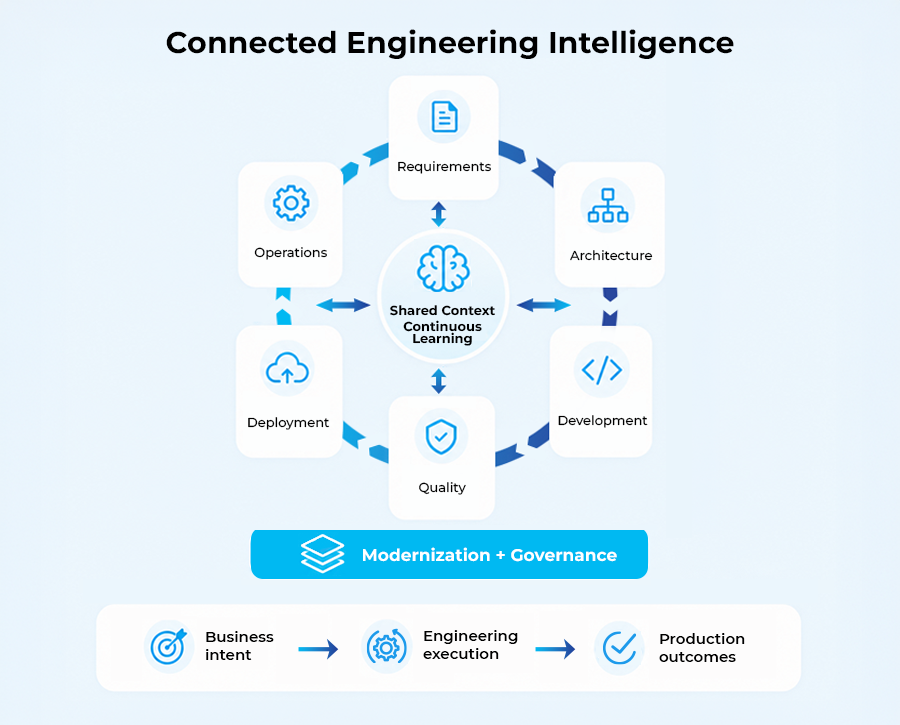
An AI-enabled operating model connects requirements, architecture, development, quality, deployment, and operations so that insights inform decisions across stages.
Cybage’s Product Intensive Engineering (PIE) 3.0 supports this approach through an AI native playbook and lifecycle agent ecosystem. OneTruth connects execution with evidence of engineering and business impact.
For engineering leaders, immediate productivity and long-term architectural resilience should reinforce each other, rather than compete for investment.
Modernization Is the Foundation, Not the Destination
Legacy architecture, fragmented platforms, technical debt, and inconsistent engineering practices constrain the value enterprises can extract from AI.
Cloud-native architectures, modern frameworks, containerization, orchestration, and automated pipelines establish the foundation. Technology replacement alone, however, does not create an intelligent engineering system.
The architectural objective is continuous exchange of engineering context.
Historical delivery patterns should inform estimation and planning. Architecture decisions should consider quality and operational evidence. Development and testing should share requirements, dependencies, and risk information. Production telemetry should influence backlog prioritization and future design. For leadership, this means treating context as a shared engineering asset: requirements, dependencies, historical decisions, and risk information must remain available as work progresses. Modernization priorities should therefore reflect how effectively platforms enable these exchanges, not just whether the underlying technology has been replaced.
Modernization becomes strategically valuable when it enables the engineering lifecycle to learn from itself.
Quality and Operations Must Become Continuous Intelligence Sources
Traditional models position quality and operations downstream: testing validates completed work, while operations manages deployed systems.
AI-native engineering makes both active sources of intelligence.
Quality intelligence should shape architecture, development, coverage, and release readiness. Automated validation, defect patterns, security findings, and change-impact analysis provide feedback before issues become late-stage release risks.
Production evidence should shape priorities. Performance bottlenecks, recurring incidents, reliability trends, and customer usage patterns inform backlog refinement and architectural improvements.
This creates a continuous learning loop:
Business Intent → Engineering Decisions → Quality Validation → Production Intelligence → Continuous Improvement
Preserve functional accountability while removing unnecessary information boundaries.
The Operating Model Must Be Designed for AI-Native Engineering
Achieving connected engineering requires more than deploying additional agents or integrating existing tools.
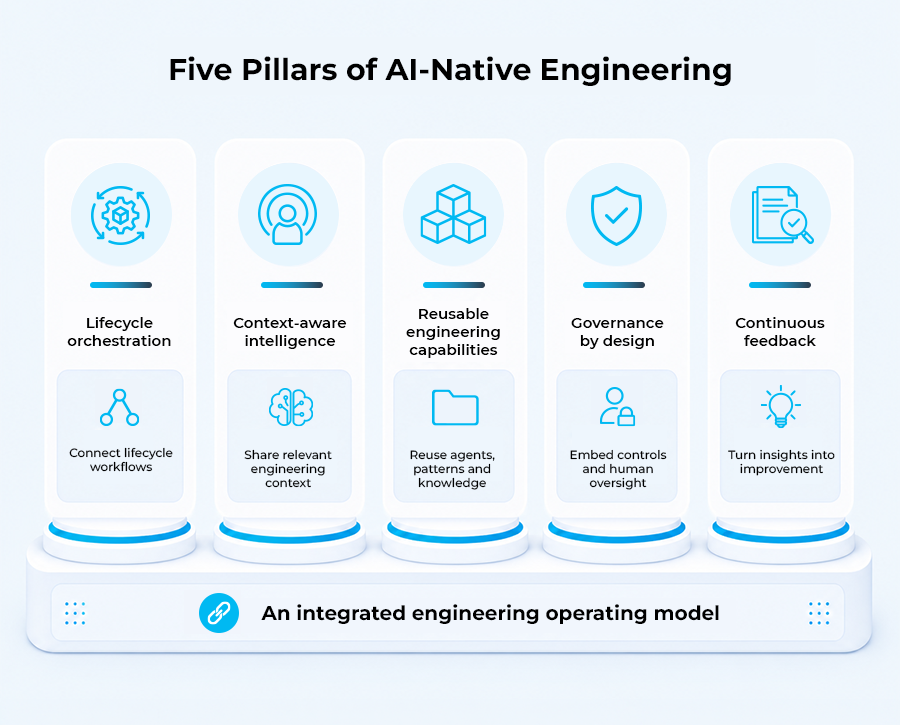
Enterprises need an operating model that deliberately combines:
- Lifecycle orchestration: Connecting requirements, architecture, development, testing, deployment, and operations through consistent workflows.
- Context-aware intelligence: Enabling engineering agents and teams to access relevant requirements, architectural knowledge, historical decisions, and operational evidence.
- Reusable engineering capabilities: Establishing common agents, automation accelerators, engineering patterns, and knowledge systems rather than repeatedly developing isolated solutions.
- Governance by design: Embedding security, compliance, human oversight, traceability, and quality controls within engineering workflows.
- Continuous feedback: Translating delivery and production intelligence into measurable improvements across the lifecycle.
Within PIE, requirements, development, review, and testing agents participate in coordinated workflows rather than operate as standalone assistants. OneTruth makes the results visible, complementing orchestration with evidence rather than another isolated reporting activity.
For a VP of Engineering, the investment test is integration: can each capability use relevant context, respect controls, and pass actionable evidence to the next stage?
The Next Competitive Advantage Is Connected Intelligence
Competitive advantage will come from connected decisions—not the number of assistants, agents, or automated workflows.
The priority is a dependable operating model that learns across the lifecycle.
Modernization establishes the foundation; AI-native workflows connect execution; quality and operations close the feedback loop. PIE and its agent ecosystem support this delivery model, while OneTruth helps guide improvement. Governance must remain integral as automation expands.
The enterprises that lead will not merely engineer faster. They will build engineering systems that continuously learn, adapt, and improve.
Authored by
Anjan Salgia
Head of Engineering Services, Cybage