

Cybage works with multiple globally distributed modern software enterprises, giving us a particular perspective and insight into adaptations—or the lack thereof—to AI. In the kinds of companies that currently control most mission-critical technology, one of the most prescient markers of success is their ability to accommodate, mediate, and resolve conflicts between different centers of power vying to define the path forward.
A key element of this conflict has always been the degree of centralized governance imposed upon business units that crave autonomy. Reasons for centralized control include real value-adds from cost reduction through reusability (developer platforms, deployment templates, etc.), cybersecurity (approved tooling, audits, and standards), and more. They also often feature out-of-touch central leaders seeking to extend their field of control into areas in which they lack working knowledge.
Within these modern software companies, AI is exposing underlying tensions in interesting ways. In broad strokes, companies tend to take one of the following approaches toward the internal adoption of AI:
- Approach 1: Here’s ChatGPT – best of luck!
- Approach 2: Here’s a light platform with available tools and deployment – build your own agents to save time in your job
- Approach 3: Hold my beer while I build opinionated agents to automate everything
Approach 1: Here’s ChatGPT – Best of Luck!
This approach ticked up when ChatGPT, Anthropic , Microsoft Copilot , and similar companies first released enterprise versions of their chat tooling. For model providers and hyperscalers, they couldn’t wait for deeper enterprise integrations before releasing their platforms. The possibility of enterprise revenue fundamentally underpins their valuations and ability to raise more capital.
In most cases, ROI was woefully hard to calculate, and some platforms—especially Microsoft Copilot—are becoming notorious as enterprise shelfware. This is due to two reasons: Shadow AI usage: individuals may prefer direct consumer AI versions unless explicitly banned by the enterprise Shallow functionality that doesn’t advance organizations toward any meaningful automation or innovation
OpenAI still seems to be coping with these limits in automation and is reportedly building a large professional services organization of Forward Deployed Engineers to embed models more deeply into enterprise decision-making on the ground.
Anthropic’s reaction is different—doubling down on Claude Code with the thesis that, ultimately, AGI means no-code, rip-and-replace software at scale.
What is clear on all sides is that more is needed; however, it remains in flux how much of this will come from foundation model providers extending out-of-the-box features, software platforms infusing AI as a feature layer, or end enterprises building custom solutions.
Approach 2: Light Enterprise Platform – Build Your Own Agents
As we move up the investment and technical value chain, multiple enterprises are taking the approach of central AI platforms that house the tools and models for teams to build their own agents. These are often built on hyperscaler infrastructure. Platforms like AWS Agentcore are reimagining compute in the world of agents, with complex needs around memory and context management.
In this case, “platforms” can imply a range of options. Some central platforms opt only for a skeleton cloud landing zone with model endpoints and centralized monitoring, while others aim to standardize retrieval, memory stores, authorization, guardrails, model gateways, and more.
Cybage is currently evolving into this paradigm with our Generative AI enterprise platform. By building standard services for agent building blocks across the enterprise, business units and individual developers can leverage these SDKs to drive new use cases.
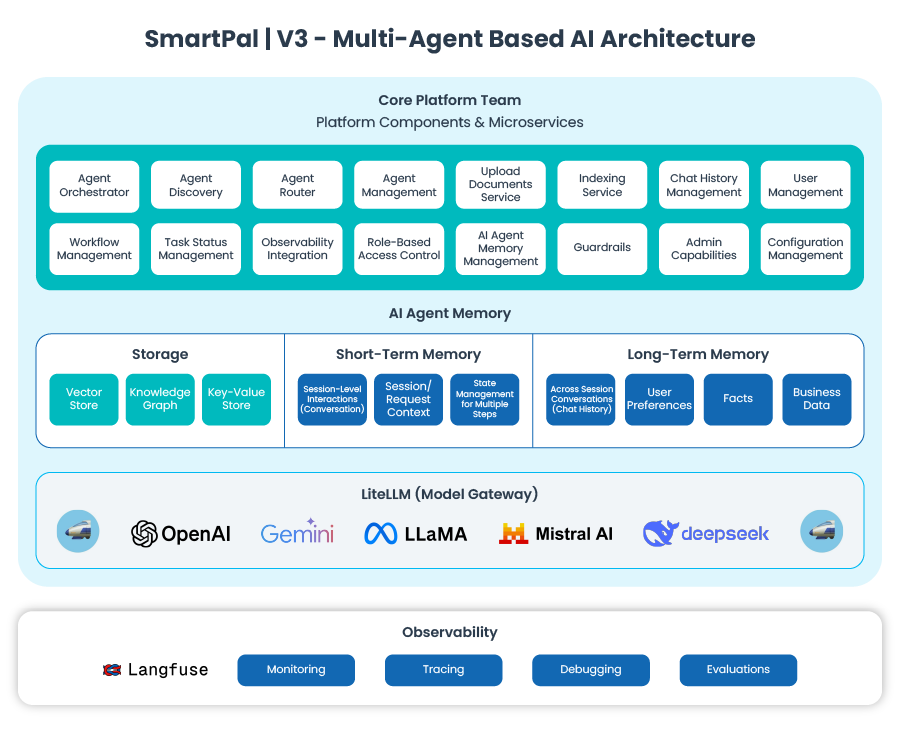
These internal enterprise platforms are rapidly evolving and often don’t need to be built from scratch. By piecing together retrieval infrastructure, model gateways (LiteLLM is our leading solution), observability (Langfuse for open source, CloudWatch for AWS), and other frameworks like Azure AgentFoundry, Agentcore, Redis, etc., enterprises can build a central development platform. This sets the groundwork for logical use-case development by creating a standard canvas to paint on.
Some companies go one step further and build or buy off-the-shelf connectors for enterprise tooling. For custom internal systems that need to connect to central SDKs in the form of tools (often MCP servers), product teams are entrusted with reimagining their APIs to be leveraged by agents.
Cybage has built a wealth of experience in building, scaling, and driving adoption of these enterprise platforms. The journey is fraught with complex business and architectural decisions, making it an exciting evolution for the modern enterprise.
Approach 3: Hold My Beer While I Build Opinionated Agents to Automate Everything
Approach 2 and Approach 3 are less technically differentiated than they are philosophically different. An AI enterprise platform can be a prerequisite for Approach 3, as it helps streamline the building of more granular agents that actually add value. However, in most cases, enterprises are taking the stance that by providing the tools, platforms, and guidance, teams and employees have the power to pick the right frontier agents and design logical human-in-the-loop mechanisms.
While this makes sense from the perspective that no one knows your job better than you do, it also introduces a key conflict in the promise of agentic AI. For agents to truly deliver outsized efficiency or innovation, there is a need to reimagine broader ways of working—not just the day-to-day activities of a developer, support agent, or HR employee.
As an example, we can see changes happening in the SDLC today. Traditionally, a major bottleneck in development projects was writing code. Today, that weight has shifted. The constraint is now around clarity of requirements and the maturity of code review.
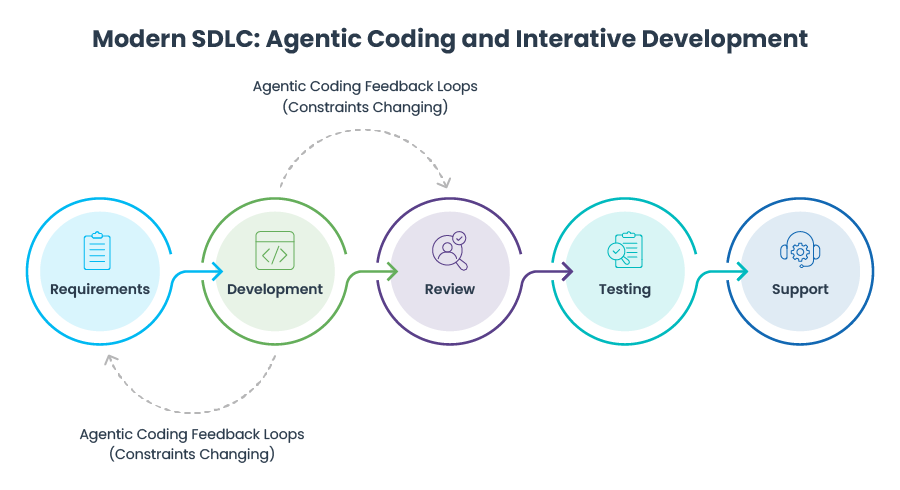
This requires rethinking not just the day of a developer, but also the way of working for an entire PoD. Agentic workflows currently tend to benefit or favor individual ownership. Handoffs of tasks and requirements become challenging due to the tendency of agentic coding to take architectural decisions during implementation, iterate on requirements in the IDE, and more.
While this thought process is becoming more established for development teams, many struggle to see how it applies to other scenarios. In reality, the same thinking can be applied across use cases. Take the simpler example of keeping a website fresh within an enterprise. This involves collaboration between marketers, content writers, website development teams, design teams, and more.
There are ceilings to how much individual AI usage can streamline workflows, improve productivity, or increase inbound leads. For example, at Cybage, to publish and maintain success stories, website development teams ask on-the-ground teams to submit spotlights on a quarterly basis from their respective verticals. These submissions form part of the outcomes measured for those teams.
We are in the process of building agents to monitor content in our CMS and automatically select, update, and highlight these success stories for the website team. This will require a logical review which, if left to the original on-the-ground teams, does not materially save time. The solution is to remove on-the-ground teams from the loop altogether and train a central website team to review vertical-specific content, with on-the-ground teams triggered only if confidence scores fall below a defined threshold.
Teams need to restructure around agentic workflows. While some shed responsibilities altogether, others must learn how to review outputs they previously accepted as fact. These cross-functional agentic designs and subsequent team restructurings need to come from a central authority, at least in the early stages of agentic evolution. This requires conviction from AI and Data Officers, along with buy-in from teams and clear direction on higher-value work that becomes available once complete automation is achieved.
Ironically, as the world appears to be moving toward a higher degree of authoritarianism, AI is asking the same question of enterprises. With the right incentive structures and growth pathways for at-risk teams, agentic AI can be unleashed across cross-functional ways of working. Until then, it will remain stuck in your browser window, waiting to be let out.
For an in-depth view of how engineering systems must evolve in the age of AI, explore our whitepaper on modern intelligent software product engineering.